Review by Ian Keogh
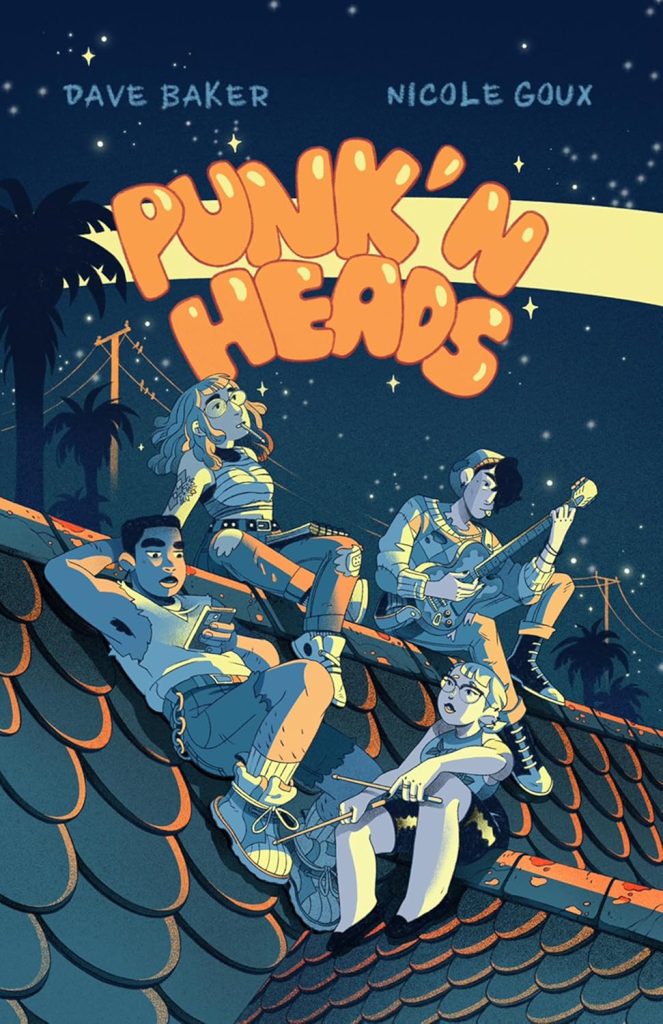
When Hannah Lipsky is dumped by her girlfriend she quits art college and moves into the shared house in Los Angeles where her friend Jerry lives. Hannah’s arrival prompts a steep learning curve for readers as it’s followed by a substantial information deposit introducing the remainder of the household, their entwined relationships, and the band all of them play in, the Punk’n’Heads. The band are masked, so when the lead singer quits Hannah could be a good fit.
Punk’n’Heads is domestic comedy drama involving a bunch of people in their early twenties with Hannah as the focus. Despite providing the title, the band is a sideline, with Dave Baker more concerned with exploring the personalities, and it’s initially difficult to work out whether inconsistencies are just down to people being contrary sometimes. As she provides the viewpoint, Hannah is someone readers are supposed to invest in as sympathetic, yet her behaviour contradicts the idea, not least her transmitting as manipulative. An early example is her statement to Jerry about being uncomfortable with direct eye contact, yet she’s frequently shown looking directly at people. As the story continues it become clearer that the negative aspects of her personality are intrinsic. Others are passive-aggressive and selfish, their dialogue expressing a need to be seen as caring while their actions are callous.
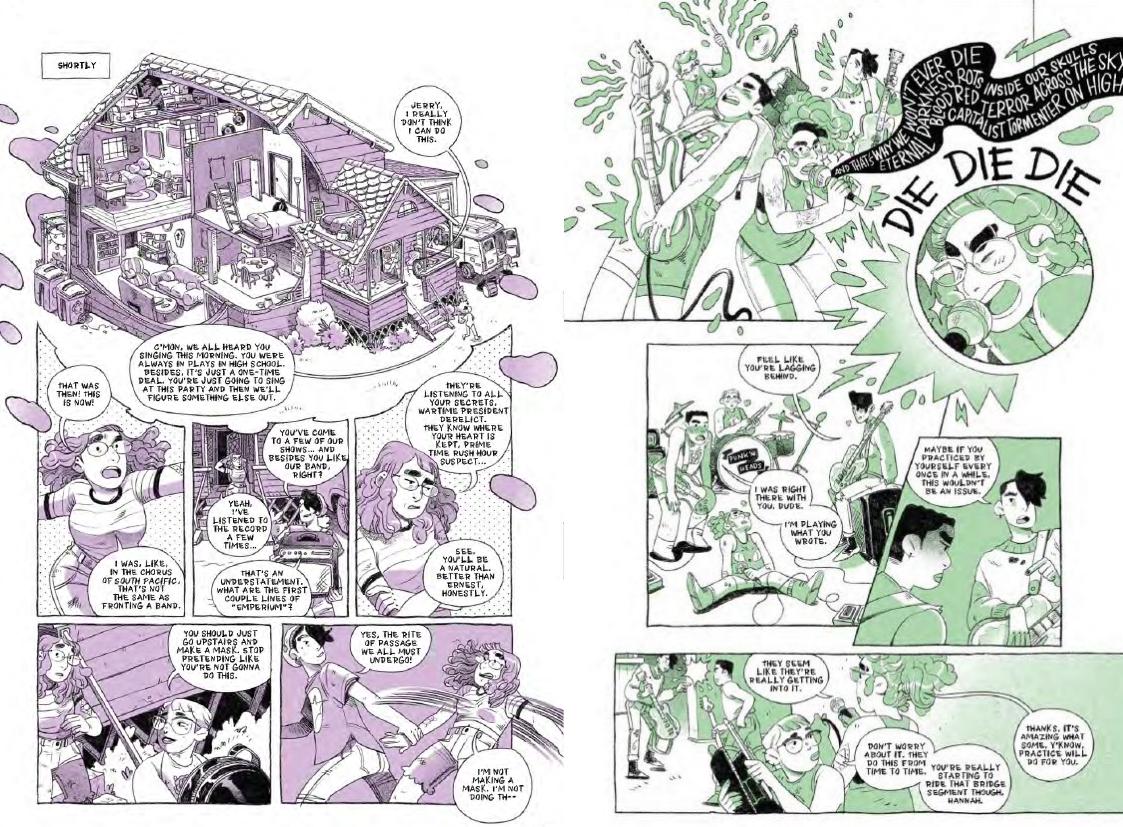
Those contradictions, though all come across extremely well due to the effort Nicole Goux puts into the art, which is exceptional. A lot of work has gone into every panel being packed, yet never to the point of obscuring the focus, what people are feeling is strong, and there’s imagination applied to the storytelling. On the sample art you’ll see people posed in ways unlikely to occur to other artists. There’s also a progression of colour, which changes with every chapter, seemingly random, but a nice touch.
When Baker’s sure we’re comfortable with the cast he broadens their horizons. Hannah is still the primary character, but the remainder of the household takes greater roles as their problems are explored. A chapter that’s little other than chat in a memorial cemetery is a highlight, and Baker drops in some pithy observations along the way as he finds creative ways to have the core cast reveal more about themselves. Captivating additional characters also turn up. Baker gradually establishes that there are greater problems than the self-absorbed consider, although two people with ill siblings is a mistake.
What begins with uncertainty develops beautifully. Readers of an age with the cast will see their lives and uncertainties reflected, while it opens a door for older readers in their comfort zone to look back and remember what a great time they had at a similar age, and how hindsight renders so many issues trivial.