Review by Ian Keogh
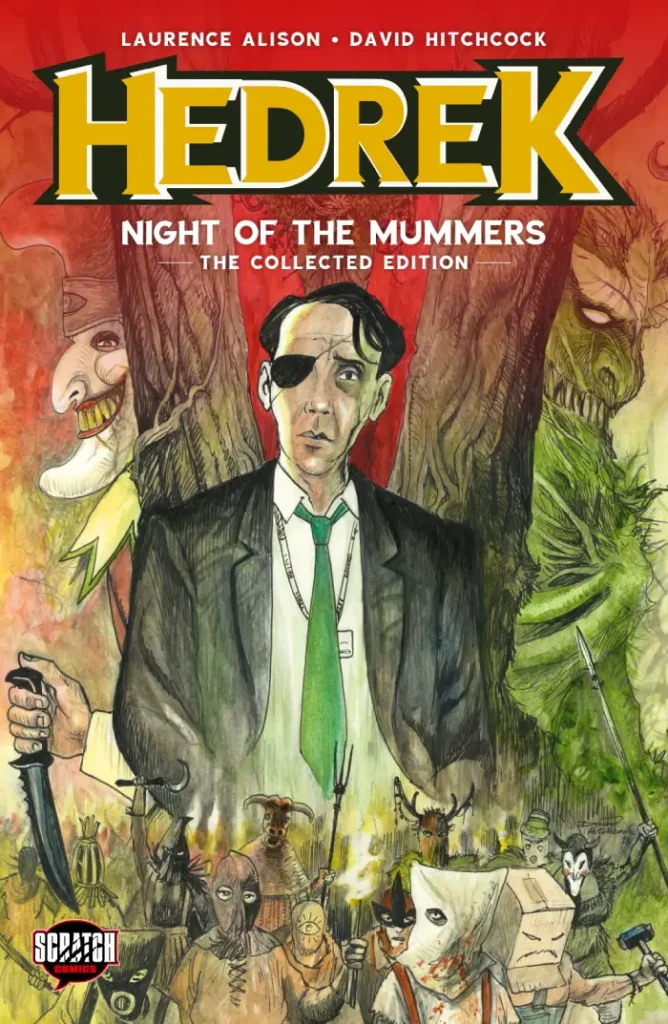
Hedrek Allen Stern is massively removed from the conventional police detective. A trait he shares with some TV and film analogues is being an outsider and the most honest man in the department, but writer Laurence Alison having a career offering psychological insight to police investigations ensures a stream of individual insights. Alison’s career perhaps also helps in creating believable characters, reinforcing the inner sadness of Hedrek being a man intimately acquainted with tragedy. Hedrek is based in Cornwall, and Alison emphasises a local accent through the dialogue.
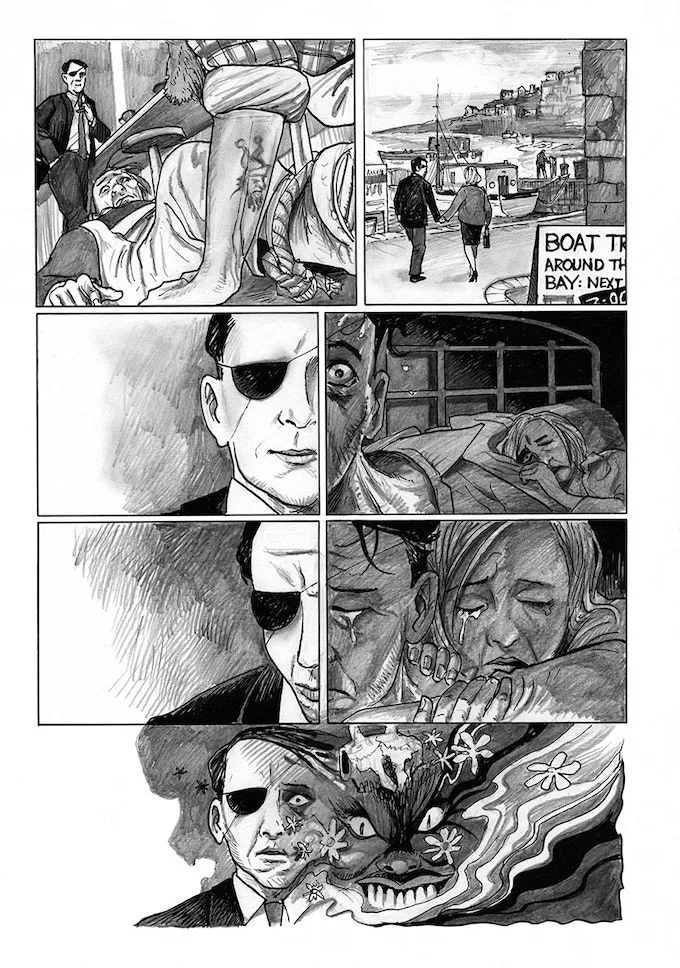
What becomes Hedrek’s problem is a very efficiently organised social uprising organised over several groups united as the Mummers, wearing costumes based on English folklore. These are very imaginatively designed by primary artist David Hitchcock, who really goes to town with the variety and their disturbing qualities. The agitation is generated from a public perception of the police being very tolerant of child abusers, exploited by a few people with nigh supernatural abilities. Every time Hedrek and colleagues believe they’ve made a breakthrough things escalate further.
Allison has a nice line in sinister rhyming captions, and takes the novel approach of separating chapters of main narrative with interludes drawn by other artists. These either temporarily move the attention away from Hedrek or are flashback sequences. Several of the interlude artists wear their influences on their sleeves, but it takes a very talented artist to even attempt working in Glenn Fabry’s style as Steve Austin does, and an epilogue that might have been a prologue drawn by Ess Kaydee really is something to look at.
Hitchcock’s art on the majority of pages is a different beast. Skilled design, detail and strong emotions are all present, but the storytelling sometimes lets him down. There’s a scene where Hedrek and his partner are abused in a cafe and it’s difficult to work out how what occurs could have happened. Under Hitchcock, though, Hedrek himself is at his most memorably downbeat, and there’s a confident switching between reality and something else.
The plot comes to involve a figure much in the mould of Jeffrey Epstein, rich and assured he’s above society’s rules. His atrocities are presumably what Alison refers to in his introduction as being events he’s come across in his police work. Their appalling nature generates a revulsion propelling the narrative, but Alison has a surprising understanding for others at first police targets. Night of the Mummers is a genuine left field oddity centred on a strong personality, never predictable and always heading somewhere new.