Review by Karl Verhoven
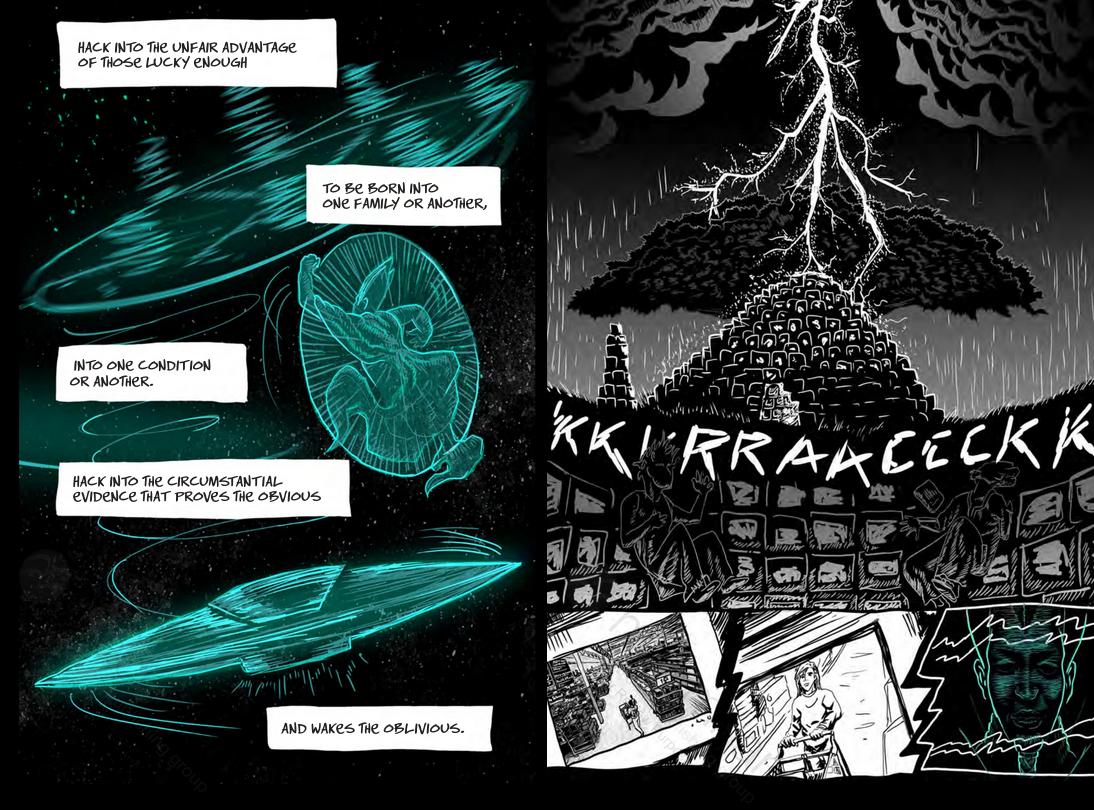
Matalusa witnesses a friend and colleague killed by a single blow to the head from a mine guard’s rifle butt in Burundi. He leaves, and in the middle of the countryside has a mystical encounter with a being exhorting him at length to hack into life. It’s a puzzling interlude, but Matalusa eventually arrives at a remote area that’s been stacked with discarded technology.
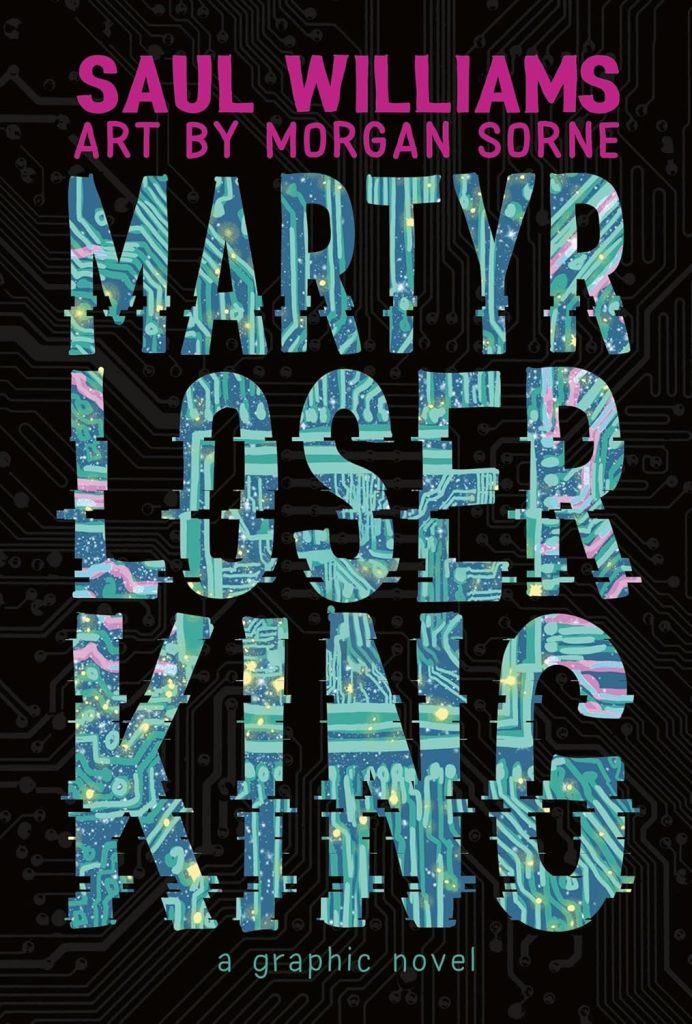
Saul Williams has an enviable artistic back catalogue, seemingly successful at whatever he tries his hand at. He’s published five books of poetry, written or starred in several films, one of which won an award at the Sundance Festival, and has released eight albums all highly rated on AllMusic.com, including 2016’s Martyr Loser King, of which this is a loose adaptation.
The CV suggests Williams as a man with considerable communication skills, but this graphic novel indicates otherwise. Clarity is a secondary consideration as Williams jumps from one scene to something completely different and seemingly unconnected, while lyrics are seemingly quoted at length. The sequence of Matalusa’s mystical experience occupies 24 pages. Characters speak in riddles and prophecies, dropping phrases like “The spirit molecule is made of many little deaths, many, many little deaths”, and “the ability to explain what one already grasps ain’t the same thing as understanding”. It’s not always the case, but frequently the presumption of depth evaporates after brief consideration. The cast quote dialogue at each other rather than having realistic conversations, which is all very staged and awkward, and not helped by Williams inserting himself into the narrative.
For much of the story Morgan Sorne’s artistic highlight is a touring avatar, seen as a modified version of Tron, all in black with green circuitry highlighted. It raises the visual interest whenever it appears, and is so imaginative when compared with the stodgy storytelling Sorne employs for conversations, with little respite from head and shoulders shots. So many comic artists should take a look at Wally Wood’s 22 panels. Illustratively, though, Sorne’s pages can be eye-catching, with the mystical elements handled better and the addition of colour a great aid. The longer the story continues the more Sorne’s art comes into its own.
At the heart of Martyr Loser King is a message to the wider world about coltan, and more particularly the human cost of mining a mineral found in so few places, yet essential to computer and phone technology. The horrors are worth passing on to a world that remains largely ignorant, but even as Martyr Loser King offers hope it’s trivialised by being pegged to the idea that music can save the world as the global infrastructure is hacked.
Well intentioned, but laboured and at times impenetrable mystical realism is the order of the day, resulting in Martyr Loser King failing to communicate.