Review by Ian Keogh
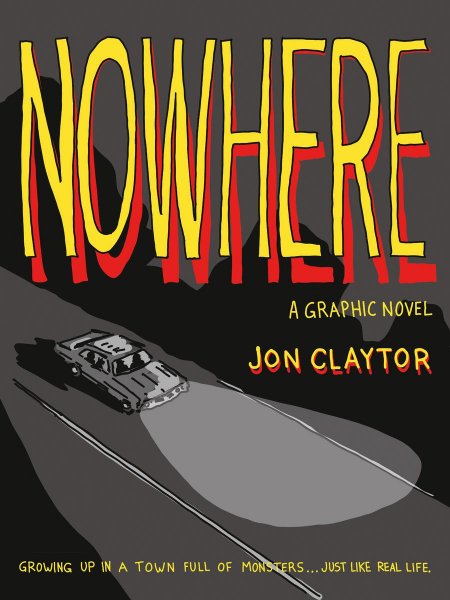
Joel’s family are moving away from somewhere in a hurry when his stepfather’s car breaks down in the small town of Beauséjour. Even at twelve Joel’s aware his mother Molly makes poor choices of partner, and Jake’s not much use when it comes to the town’s individual quirks. For starters there’s a massive white cube that just appeared overnight, with no-one knowing what it’s for, and then there are nights when the zombies are out.
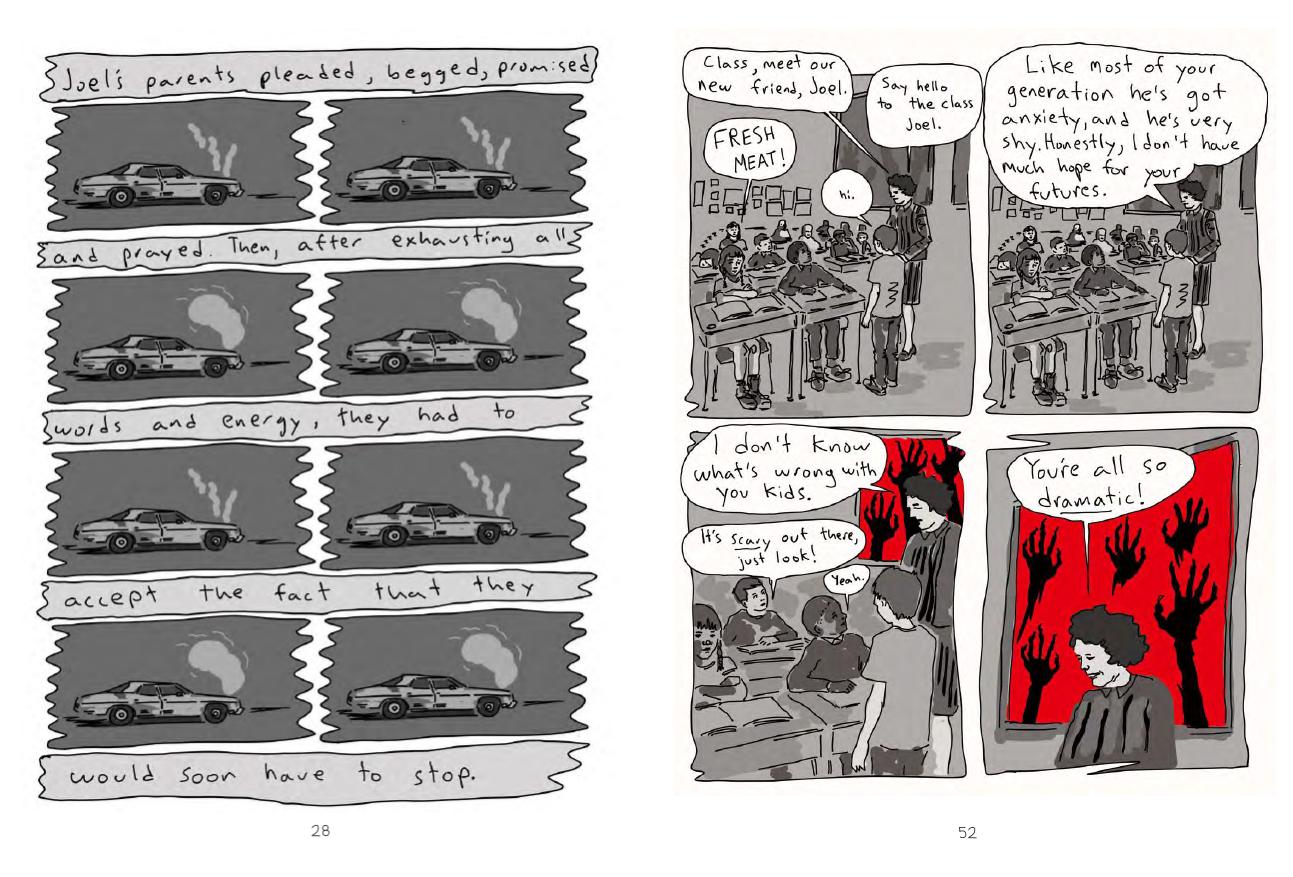
That’s well treated by Jon Claytor, who has the inhabitants accepting it as an occasional hazard of their location, which can be avoided by staying indoors and keeping the lights off. The zombies are literal, but Claytor takes an impressionistic approach to other inhabitants, such as all potential landlords being portrayed as forms of demon. Many pages are devoted to illustrations of Beauséjour, individually very attractive sketches, but while they first serve up an atmosphere of danger and desolation they’re eventually padding a story that would have been more effective at half the length. The left sample art represents an irritating technique of repeating the same panel over an entire page used on other occasions early on before the idea is dropped. The right sample art shows the impressive use of red as an additional colour when horrors are about, sometimes just for a creature’s eyes.
The sketchy and repetitive art disappoints further alongside Claytor having ideas needing to be expressed more cogently rather than as brief vignettes. The family car drives around town on its own at night, clowns and vampires have therapy and when Joel moves back into the spotlight the emotional resonance increases. His life is one of impermanence and uncertainty, and his thoughts and observations build sympathy. Were all short sequences as creative, Nowhere would be a better experience, but in attempting to generate the tedium of life in a small town where everyone and everything is known Claytor moves in circles for too long.
It’s halfway through before a more traditional plot kicks in, with the town concerned about the increasing frequency of people disappearing, and the aliens we’ve seen obviously behind it. Their purpose is never clarified, although they enable a metaphor for isolation.
At half the length and greater focus Nowhere might have had something to say, but the meandering and repetition torpedo the engaging ideas.