Review by Frank Plowright
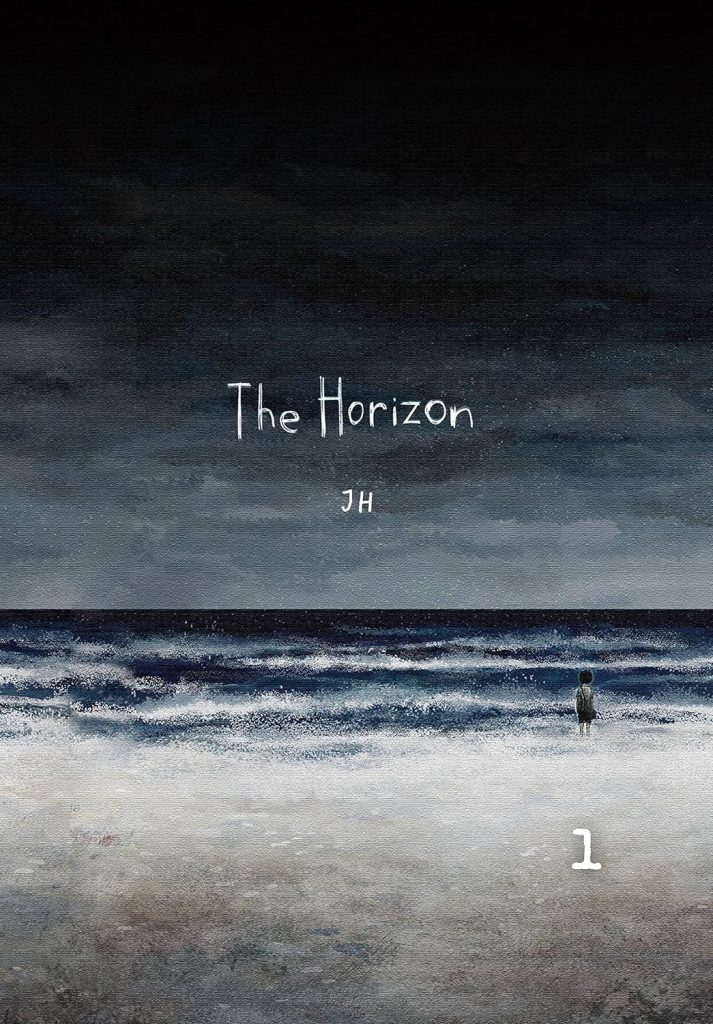
A bleak cover tells no lies about a bleak opening volume to The Horizon, which begins with a young boy being the only survivor when his community is slaughtered. It’s part of a far wider disaster that few survive, and the boy begins to wander. He spends a night in an abandoned bus later boarded by a young girl, and they’re able to escape the area as war breaks out around them.
Korean creator Jeong Ji-hun was credited with his full name for the 2020 digital release, but only by initials for physical versions of The Horizon’s English translation. It’s a dark story of survival against impossible odds. The boy and girl are never named, and are drawn as primary school age, the youth accentuated via disproportionately massive eyes. The theme of never specified disaster, the surely inevitable succumbing to tragic circumstances, the struggle for survival and frequent illustrative reminders of the title bring to mind the dystopian horror of Cormac McCarthy’s The Road. The horizon itself provides hope of something better, but is an ever-present illusion, yet the children believe the road will end.
Their hope, though, is fractured when a man behaving strangely begins to accompany them, emitting only strange screams, but powerful enough to steal food and water from them. Much of this volume becomes their attempts to escape him. It’s a simple plot, yet a compelling one as the children realise their survival is at stake. Readers will be invested in that, yet the man’s behaviour is so beyond the norms of expectation his unpredictability supplies a constant unsettling threat.
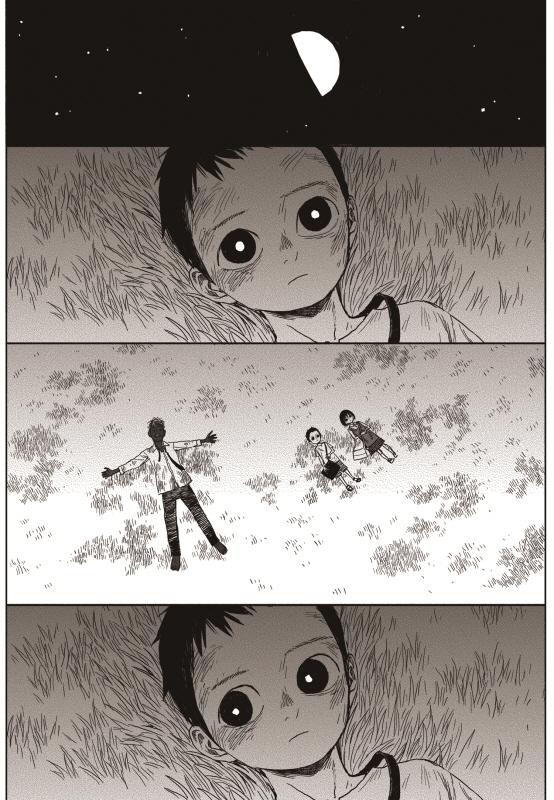
JH conveys a desperate world in stark black and white, yet due to the scenery being predominantly a road, a field and the horizon, the emptiness is constantly reinforced. For the opening scenes of terror there’s a different approach, some panels seemingly white revealed on scratchboard for ghostly terrified faces. It’s a haunting effect, and repeated later in the story for a different, but equally effective purpose.
In using children as protagonists JH amplifies the horror, and their lack of some awareness is both endearing and unsettling. They’re well written as children seeing simple solutions to situations that adults would consider impossible in talking of a world where no-one gets hurt and no-one is lonely.
That dream is ripped away via a violent ending and one of the few times colour intrudes on the black and white art. The story continues in The Horizon 2, and the likelihood is anyone having read this moving portion will want to know what happens next.