
Review by Frank Plowright
Ruka has befriended two strange children more at home in the sea than on land, and with acute sensitivities when it comes to marine events. Children of the Sea 2 closed with Ruka witnessing Sora’s apparent transformation and disappearance, but just before departing he transferred a small meteor that she now carries internally. Ever since she’s been feeling feverish and behaving strangely, explained by Umi as half of her sleeping while the other half is deep in the sea. Much of what’s set in the present day here is Umi and Ruka exploring that in the company of renegade marine researcher Anglade.
However, the mysteries of the present are largely to be saved for Children of the Sea 4, as this volume is primarily concerned with the past and explaining the connections between assorted people seen in the present. Daisuke Igarashi has told versions of how Sora and Umi were first seen swimming with dugongs, but in this volume for the first time shows their discovery before jumping back further to view them as extremely young, then forward again to their first meeting Jim Cusack. Before their capture Igarashi draws a long wordless sequence of their playing in the ocean alongside whatever marine life manifests, with Sora caring for the younger Umi. It’s representative of the series heart in proceeding leisurely and reveling in the ocean and the life it contains.
However, for all the spiritual appreciation Igarishi’s not above dropping some chilling material in passing, not least a comment made about the young Anglade, now revealed to be a child prodigy.
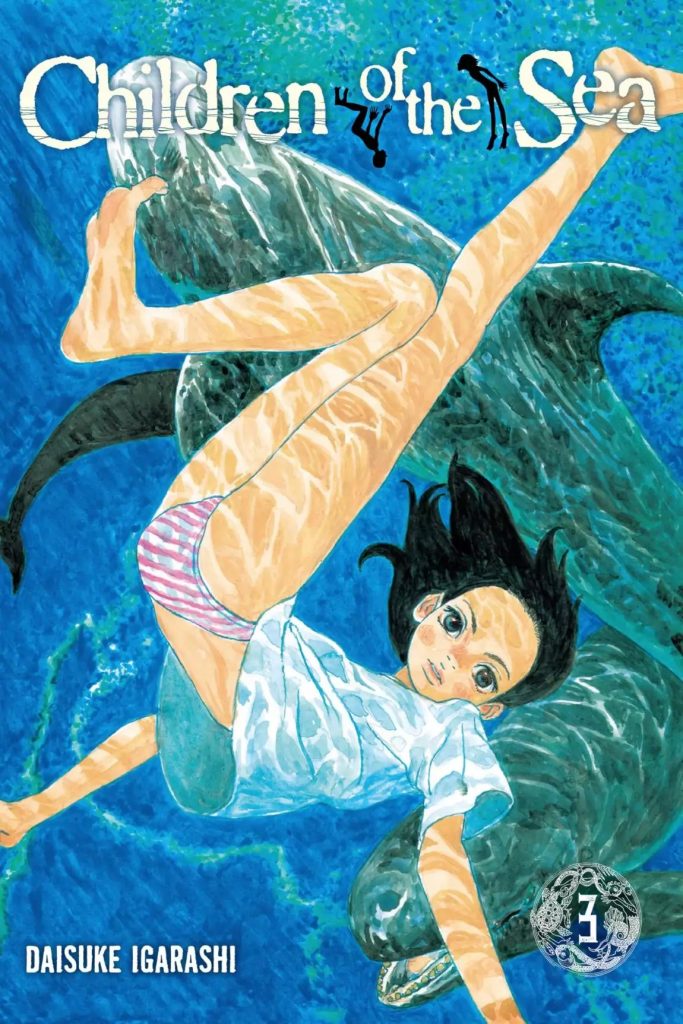
Most of Igarashi’s art is very attractive, yet slightly sketchy black and white inspiration, but there’s a colour section to this volume. It’s set underwater, and Igarashi creates magic from blue and grey watercolours with the occasional flesh tone.
When the narrative moves back to the present much has been explained, but splicing past and present is another interlude chapter of Igarashi interpreting a sea myth. These are consistently fascinating, and by the end of this volume it seems they have greater purpose than enjoyable narrative separators. Cusack believes that because similar creation myths occur worldwide, there may be truth to them, and Sora and Umi are proof. Whatever the truth of that, Ruka’s new experiences are flooding rapidly forward, and she’s seemingly now closer to whatever Sora and Umi are than to her previous human state. Much awaits to be disclosed in the next volume.