Review by Lewis Savarese
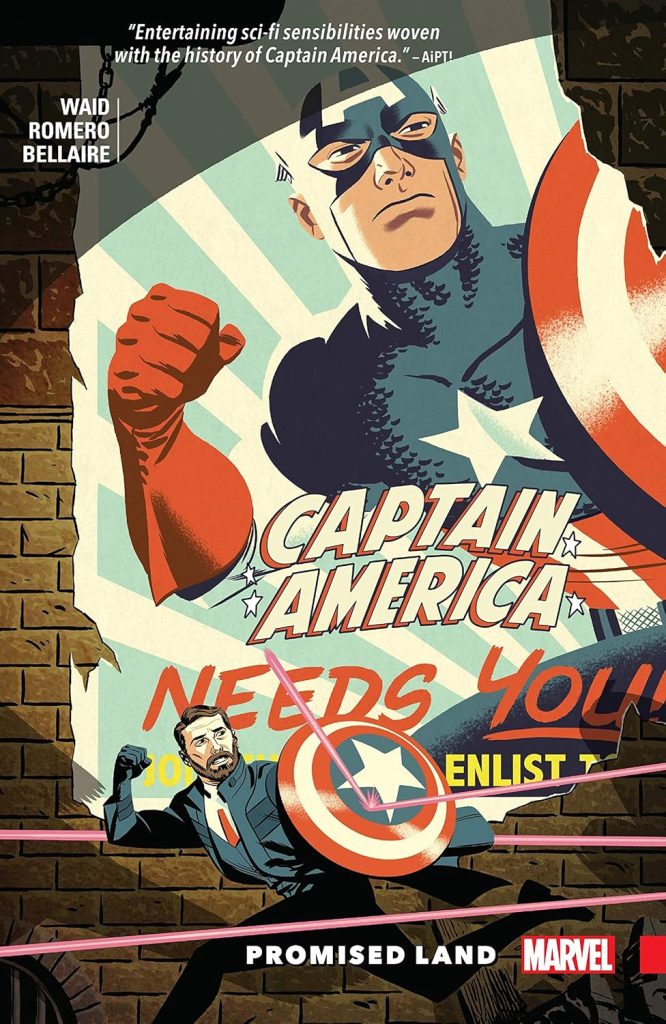
In Promised Land, Mark Waid takes us to the far-off future of 2314 to explore Captain America’s lasting legacy on the United States and its people. For this closing volume of the Marvel Legacy initiative, Leonardo Romero takes the artistic reins from Chris Samnee, with a handful of additional artististic contributions throughout. As more of a spiritual successor to Captain America: Home Of The Brave than a true follow-up, Promised Land is a competent yet inconsequential entry in the Captain America mythos.
After the death of Captain America, scientists used a derivative of the super-soldier serum to create a formula to eradicate all diseases and extend the human lifespan. This formula, administered to the American people like a vaccine, ushered in a utopic era where America is a beacon of peace and prosperity across the galaxy. Our window into this utopia is the great-great-grandson of Steve Rogers, a historian by the name of Jack Rogers. While Jack reaps the benefits of his great-great-grandfather’s legacy, his son Steve is a sickly, bed-ridden teen whose body has rejected the formula. When the President of the United States denies Jack’s request to declassify the records regarding the creation of the formula, Jack begins his own investigation.
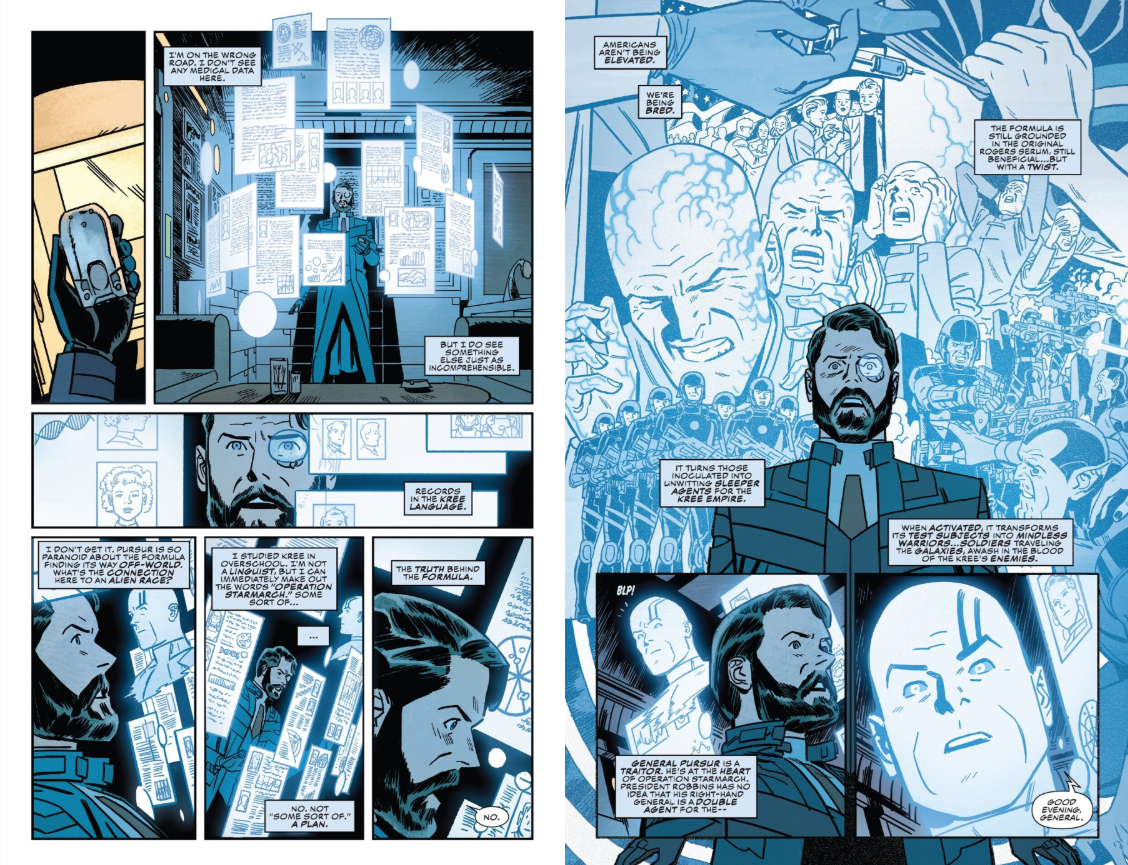
Unsurprisingly, Jack uncovers a vast conspiracy that ultimately alters the course of American history. As soon as a panel depicting a poster emblazoned with the proclamation “Make War No More: Americans and Kree Allied” appears, you can assume something foul is afoot. It is revealed that the ever untrustworthy, militaristic Kree were instrumental in developing the formula which, when activated, can turn those inoculated into mindless warriors. Jack fights back against the Kree using a secret he learned from his ailing son’s genes, and the help of an unexpected villain from Captain America’s past.
Promised Land feels like an inverse of Home of the Brave, in which Waid attempts to portray the pitfalls of a utopian state as opposed to a totalitarian one. Where, instead of allies from Cap’s past aiding him in the fight against oppression, one of his greatest foes helps his descendant wage war, utilising morally grey tactics. The nuance of Home of the Brave, especially the notion that Cap’s past as superhero and soldier did not appropriately prepare him to rebuild a nation, is largely absent from Promised Land. Jack Rogers is near infallible, prepared for this moment in time because he is a historian. He has learned all the right lessons from the past, which he can experience via one of the government-modified fragments of the Time Stone called a timelens. Apparently Waid cannot see into the past though, as he crafts a story where Jack Rogers calls the Kree plot “eugenics.” Jack is fighting for a utopia awash in eugenics, where everyone is given a formula that makes them able-bodied. Examining this aspect of the story would have been more compelling than a Kree contrivance.
Leonardo Romero is a worthy successor to Samnee. His art is clean, his layouts are distinct, and he packs each panel with intricate details that add to the worldbuilding. Romero has a knack for faces, keeping them consistent and expressive throughout. Six additional artists contribute a handful of pages total, depicting Captain America’s past exploits as seen through a timelens. Rod Reis and Adam Hughes’s WWII stories deserve to be expanded into a series. Each of these straightforward flashback stories, also written by Waid, come across as more sincere and entertaining than the main story.