Review by Ian Keogh
Although Czech writer Karel Čapek never won the Nobel Prize for Literature, seven nominations speak to his track record, and during the 20th century his work was banned by both Communists and Nazis. Additionally he’s a science-fiction pioneer who introduced the word “robot”, although Mark Bould’s informative introduction reveals it was actually his brother who suggested the term. R.U.R, standing for Rossum’s Universal Robots, is a play first produced in 1921, and here adapted by Kateřina Čupova.
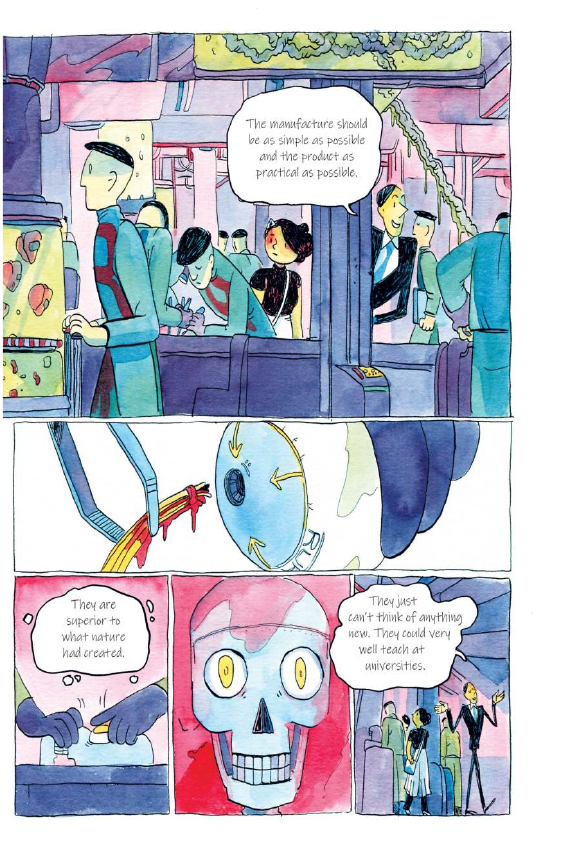
She takes an interesting approach. Instead of a tight, sterile world of mechanisation suggested by robots R.U.R. is presented via expressionism, loose, sketched people and vivid colour. It would seem she also expands on the scope of a staged play as some scenes feature outside locations, such as the scale of an island robot production factory only reached by sea.
Čapek set his play in the future, and in this world robots are such an alien concept that when meeting a robot secretary the President’s daughter Helena refuses to believe it’s not human. She represents the fear of the future, the only voice of concern about the displacement of humanity in the face of commercial concerns.
Counterpointing Helena’s anxiety is Harry, the factory owner, absolutely confident in his product, boasting about how robots will never learn and are devoid of emotion. Despite their human form, he views them absolutely as machines, and there are numerous cold references in passing. In one scene a technician is refining the robot design in order that they feel pain, the reason being that if they don’t they’re more likely to damage themselves and shorten their working lives.
A subplot of Harry repeatedly asking Helena to marry him is clumsy, yet that’s what happens as the story proper begins. Ten years have elapsed, things have started going wrong, and Harry is keeping this from Helena, while presenting her with a warship to celebrate their anniversary. Things deteriorate considerably from there, but the one item of hope is robots unaware of how to manufacture more of themselves.
That may suggest Čapek’s view as dystopian, but he was relatively optimistic. The ending is a form of survival, and in his world robots would take over the menial tasks and free humans to create, with one voiced fear being unproductive humans. The attitude now would be the industrial owners of robots maximising profits and not seeing it as their concern or responsibility that former workers starved. Čupova brings through obviously satirical elements, and downplays the dangers. Some views would now perhaps seem too simplistically presented, primarily Helena’s marriage for the sake of the plot, but Čapek certainly understood human nature in other respects.
A century later AI prompts similar concerns, ensuring R.U.R. is restored to contemporary value.