Review by Win Wiacek
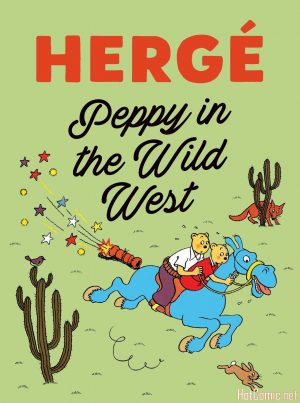
George Remi, world famous as Hergé, had a long creative connection to Catholicism. At the behest of the Abbot Norbert Wallez, editor of Belgian Catholic newspaper Le XXe Siécle, he created Tintin before moving on to such strips as the mischievous Quick and Flupke, Tim the Squirrel in the Far West and Peppy in the Wild West. This was all while continuing the globe-trotting adventures of the dauntless boy reporter and his faithful little dog.
In 1935 he was approached by French weekly newspaper Coeurs Vaillants, which already ran Tintin’s adventures, to create a new strip portraying family values. The subversive and mischievous, trouble-making working-class boy rascals Quick and Flupke presumably wouldn’t do.
Hergé developed the Legrand family, consisting of a working father, a housewife and mother, a young boy and his sister, and a pet. The latter was Hergé’s non-conformist element. Instead of a dog or cat, the Legrands had a small, feisty monkey, or probably, more correctly, an ape, as the creature has no tail. Apparently it was a toy monkey called Jocko that inspired the entire strip.
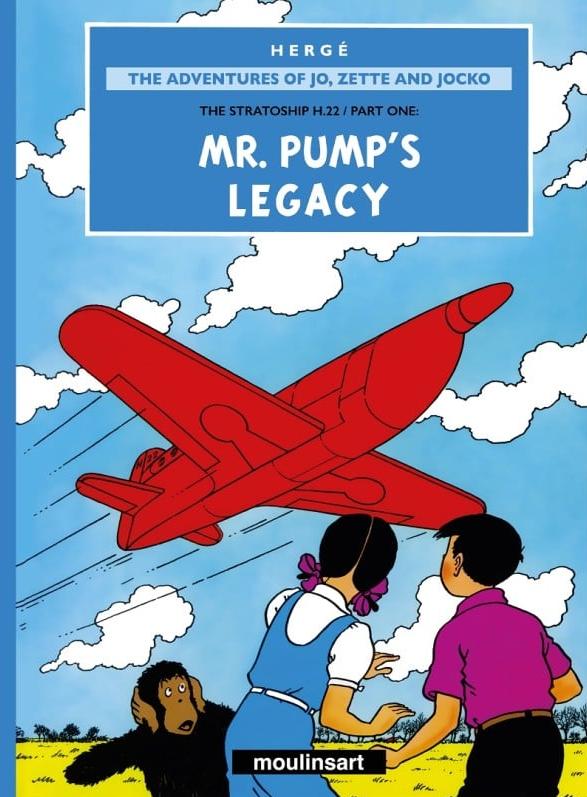
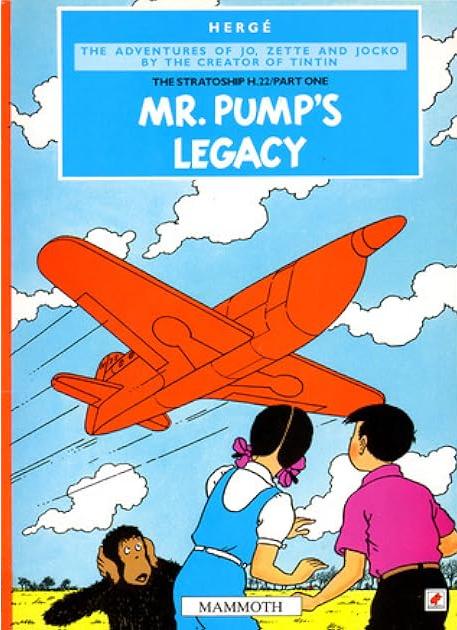
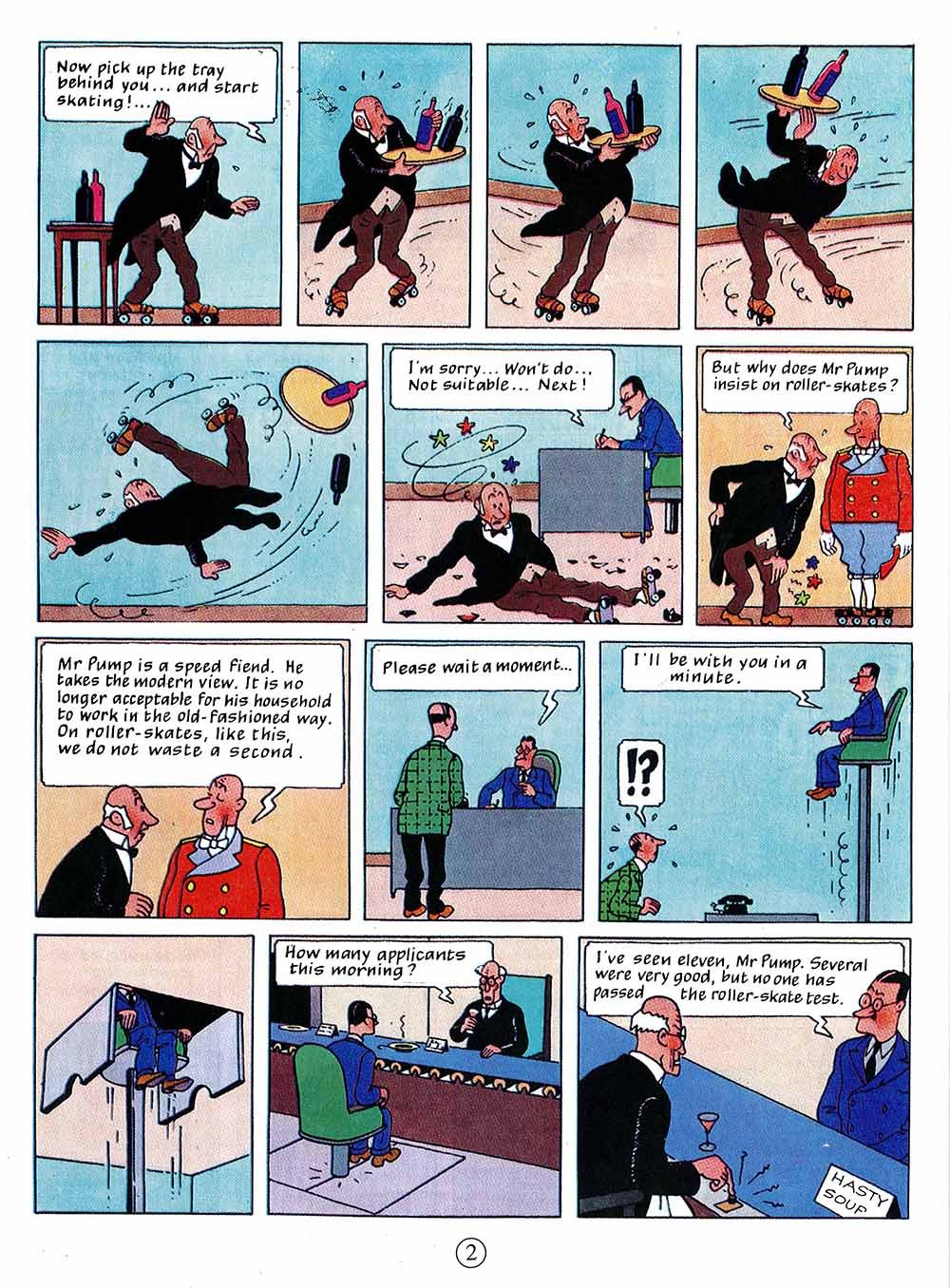
Monsieur Legrand is an aeronautical engineer, enabling access to an exciting world, investigated in Mr. Pump’s Legacy. When the “American Collar-Stud King” John Archibald Pump dies in a car crash at 155 mph, he probably went surprised but happy. That’s because he was a septuagenarian millionaire-technocrat and unrepentant speed-fiend (that’s velocity, not pharmacology) and adrenaline junkie. On his remarkably rapid passing he leaves a ten-million dollar prize: an incentive for the first person or persons to fly non-stop between New York and Paris at an average speed of 1000 kilometres per hour. Accomplishing that modern miracle will secure said cash, but if nobody wins within one year the money will revert to his ne’er-do-well nephews.
The contest captures world imagination in the Age of Speed, and many try for the prize, including S.A.F.C.A., the aeronautical company that Jacques Legrand works for. Very soon both the engineer and his family become the targets of skulduggery and sabotage as his groundbreaking design gradually becomes a beautiful flying machine.
Assaults, poison-pen letters and threats, murder attempts, blackmail and even kidnapping; nothing can impede the project whilst canny Jo and Zette are around to foil them. Even when the completed plane is targeted by an aerial bombardment, the resourceful children have a solution. Starting the plane, they fly away from the bomber, but become lost in the night and clouds.
With their fuel almost exhausted they spot a tiny island in a vast sea and manage to land the plane safely. How can they return the ship in time to win the Prize? Without food, water, fuel or any idea where they are, can they survive long enough to be found?
In the mid-1930s Hergé was a master-creator rapidly reaching the peak of his powers, and Mr. Pump’s Legacy combines all-ages thrills and slapstick comedy with magical art and superb designs leading to a cliffhanger ending picked up in Destination New York. It’s a true lost classic adventure, and one worthy of much greater public attention.