Review by Ian Keogh
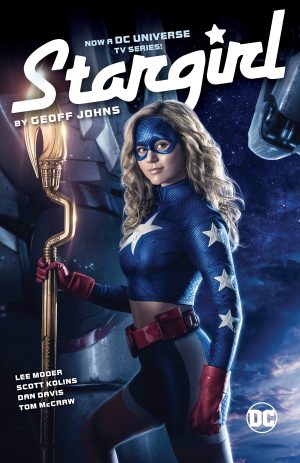
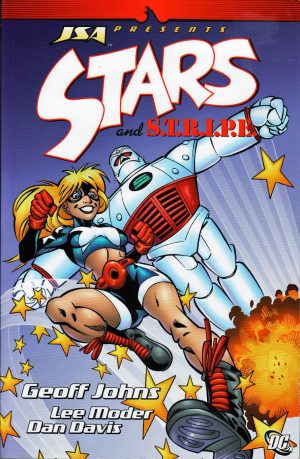
Courtney Whitmore was created by Geoff Johns very soon after he began working for DC during the late 1990s, and he’s remained very fond of her ever since. Now known as Stargirl, she’s progressed from the enthusiastic young teenager to a capable hero with experience in using the gravity rod inherited from Starman.
It’s a legacy super power, and just as Johns’ JSA work prioritised legacy, so does Stargirl and the Lost Children. Concentrating on the past and tying up matters of continuity is rather a surprising direction to take for a graphic novel issued to tie in with Stargirl’s TV show, when the assumption would be that clarity for new readers would be a priority. However, Johns is experienced enough to ensure that by the time the action begins in the opening story everyone is brought up to date on obscure 1940s super team the Seven Soldiers of Victory, as per Todd Nauck’s sample art.
The opening chapter is a set-up featuring the entire team, but ensuring Courtney’s centre stage to learn that the Crimson Avenger’s sidekick Wing may not be dead after all. In fact many of the young sidekicks who accompanied the crimefighters of the 1940s seem to have disappeared, and the main story is Stargirl joining forces with Red Arrow to discover what happened to them.
Todd Nauck’s superhero art here is phenomenal, so far removed from the talent who once prioritised style over content. The pages move the story forward efficiently, occasionally pausing for an astonishingly decorative spread packed with detail George Pérez might have thought twice about. The scenes set in Green Arrow’s long forgotten Arrowcave have to be seen to be believed. Nauck’s called on to update and redesign so many characters, and there’s a cheerful, friendly quality to his cast, which is appropriate as most of them are youngsters.
Encompassing them all brings the plot juddering to a halt around halfway through, Johns supplying page after page of introductions over half a chapter, more concerned about the formality than considering how small a part most later have. It’s followed by further references to DC’s complex continuity when surely the route to maximum enjoyment would have been to leave well enough alone. Stargirl: The Lost Children is better when moving attention away from Stargirl and the baggage she accumulates and to the villain of the piece, although Nauck is never better than when illustrating dozens of characters.
Johns may prioritise dragging the 1940s into the 2020s, but there’s also a place for a character of more recent vintage, and they’re an enjoyable presence for those nostalgic for the 1990s. Overall, though, Nauck is the star turn elevating a story surely begun with good intentions, but probably opening a door that would better have remained closed. Anyone who disagrees, though, might look to Justice Society of America: Long Live the JSA for a sequel.