Review by Frank Plowright
Anyone who’s been following Riad Sattouf’s absorbing memoir of his youth over four previous volumes will be grateful Fantagraphics have picked up the English translations to see the series through to the end.
Those earlier books were an astonishing chronicle of a Syrian studying in France, qualifying as a professor, marrying a French woman and then moving his family back and forth between France and assorted Arabic nations. The result was a nomadic childhood where the young Sattouf could never settle and was always an outsider.
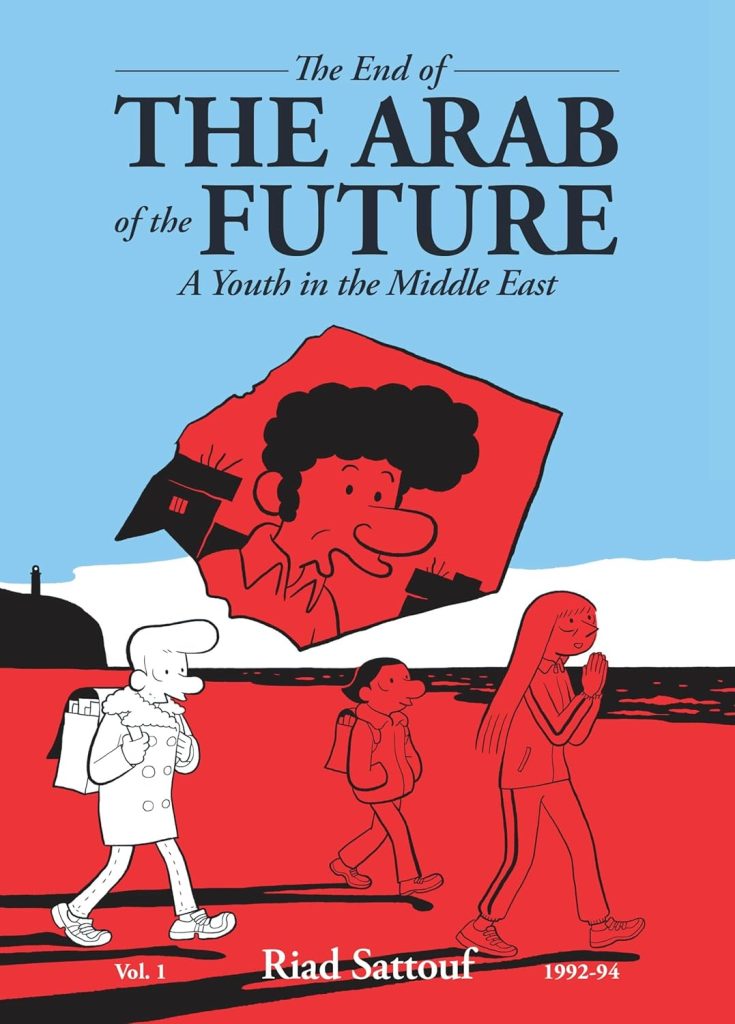
By 1992 he’s fourteen and living in France with his mother after she refused another move back to Syria. His father’s response was to abduct Riad’s younger brother, which is where The Arab of the Future 4 ended. Sattouf has constantly presented jaw dropping moments, yet his upbringing continues to astonish as he diligently explains his world. Coping with his brother’s disappearance probably isn’t the best time to be introduced to the disturbing stories of H.P. Lovecraft, especially since a belief in the supernatural extends throughout the family. At least there’s the joy of first love to mitigate the upset.
Because The Arab on the Future is so involving, the drama so constant and the detail so compelling there are times when absorption is so thorough that this actually being Sattouf’s horrendous childhood is forgotten. His memory for small moments all these years later is astounding, but they flood out. Liking a TV comedian for the rarity of being able to make his mother laugh is an example, and unlike earlier volumes where Sattouf senior’s delusions and extreme behaviour have been a constant accompaniment, he’s barely seen here. His actions, though, ensure he’s constantly hovering. Sattouf presents his mother as he viewed her when young, but it’s enough to cultivate sympathy for the horrors she’s enduring and how desperate she becomes.
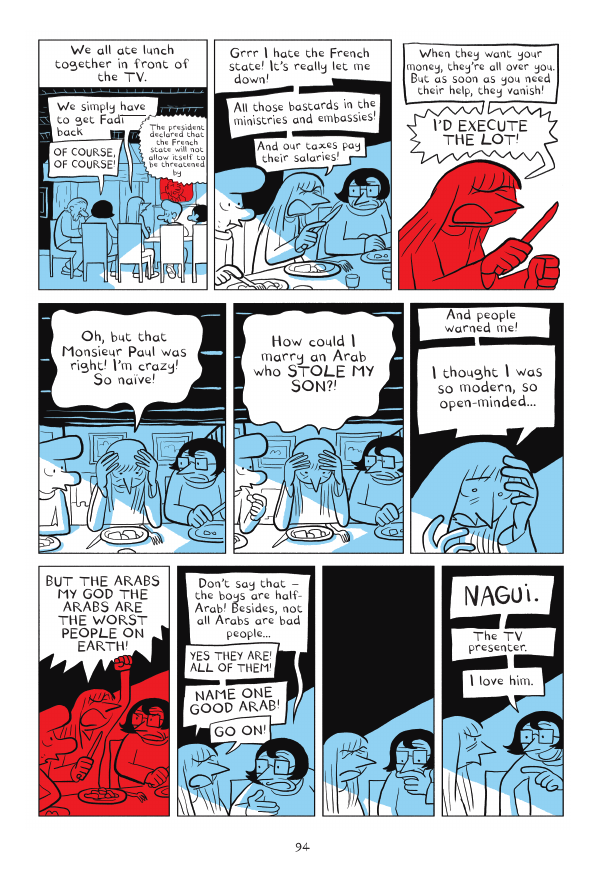
When Sattouf senior re-emerges near the end, the young Riad confides his intention to draw comics for a living and includes his father commenting that only gays draw comics and it’s not art. It’s beyond irony in the face of cartooning excellence. There’s a goofy quality, yet Sattouf utterly defines people and what they feel in so few simple lines, losing no power or charm for being compressed into pages almost always employing a nine panel grid. Whereas in previous volumes different colours have been used to distinguish different locations, here Sattouf uses red for visual thought balloons, fantasies and the hair of Anaick, his would-be love.
A constant theme is impotence, both on the part of the young Riad unable to express his feelings, hardly unusual for teenage boys, and on the part of the French authorities. They’re either unable or unwilling to do much to return Riad’s younger brother to his mother. Does it happen? We leave in 1994 with a final volume concluding the series still to come.