Review by Ian Keogh
Raoul Cauvin and Willy Lambil created many stories of The Bluecoats, but the English translations follow no logical order, dipping back and forth through almost fifty years. As continuity is minimal, that’s fine, but over the series the creators waxed and waned, so quality levels fluctuate from one translated story to the next. After a few disappointing translations preceding it, Drummer Boy is Cauvin and Lambil on peak form.
From the series beginning there’s been a tension generated by the contrasting personalities of the two main characters. Chesterfield is more gung-ho and has a respect for the chain of command, while Blutch initially wanted nothing more than to return home, and so connived ways to leave the army. As the series continued, though, Cauvin broadened Blutch’s character, fortifying his principles into a more committed anti-war stance.
His anger is roused early in Drummer Boy when he sees a young teenage boy in a queue to sign up for the army, aware of what might lie ahead for the youngster who doesn’t know what he’s signing up for. It’s well contrasted by the ludicrous optimism of the officers who believe the war will be over in a few days, all evidence to the contrary. That evidence is graphically provided by Lambil on the opening page, showing the slaughter of a battle as part of what’s a masterclass in how to tell a story economically without stinting on the actual drawing.
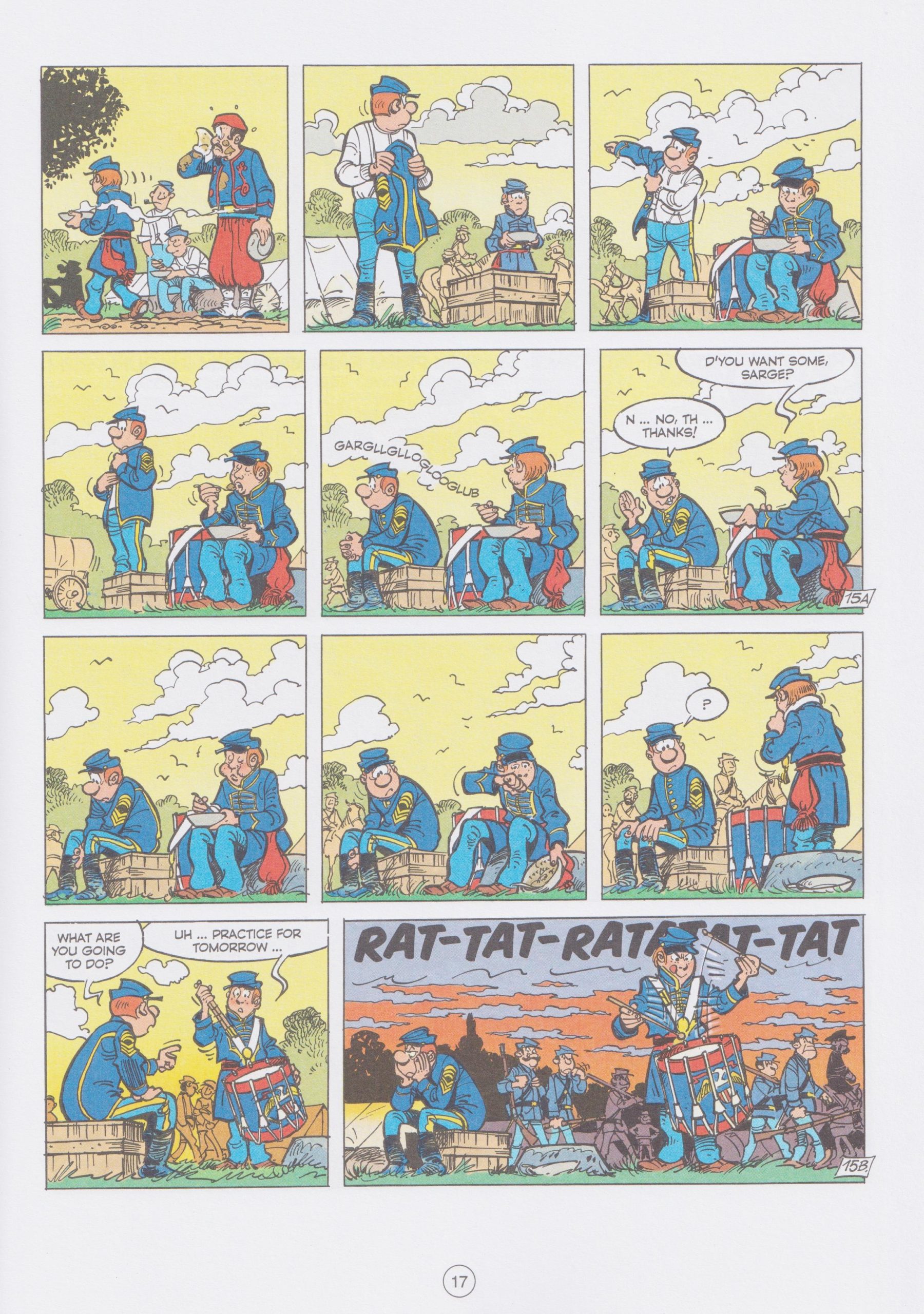
That’s not the only scene of slaughter. While keeping within the requirements for an all-ages audience, Lambil uses half pages to leave youngsters in no doubt what the reality of face to face combat is. The cartooning is again magnificent, full of life and energy with imaginative panel compositions packed with people and objects, yet never seeming crowded. Lambil’s reputation among the European cartooning greats is nowhere near as high as it ought to be. Pucky the drummer boy is gloriously drawn throughout as seen on the cover, with his tongue out as he concentrates on his drumming.
Both creators insert a fair amount of sly satire about Confederate and Union armies having to recruit foreigners, poking fun at their own nation by having a Belgian illustrated with a poke of chips, and showing assorted others in their 19th century national dress. Given the title, there are also jokes both visual and verbal about the irritant someone constantly practicing the drum becomes. Pucky, the young recruit, takes his drumming seriously.
Around midway Cauvin drops a great revelation, yet it’s merely a staging point allowing for the return of Blutch’s humane views outranking orders, and the surprising, but brief, return of a character last seen in the first English language translation, Robertsville Prison. Cameos and points of view are all well and good, but Cauvin and Lambil turn in another fine comedy adventure, one of the best so far translated.