Review by Win Wiacek
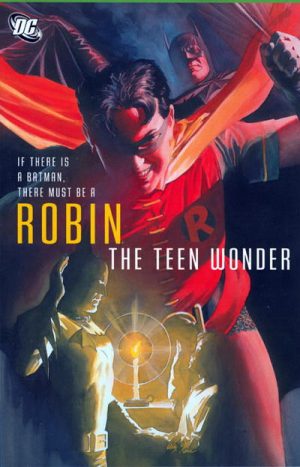
Robin the Boy Wonder débuted in April 1940, created by Bob Kane, Bill Finger and Jerry Robinson who introduced a juvenile circus acrobat whose parents were murdered by a mob boss. The story of how Batman took the orphaned Dick Grayson under his scalloped wing and trained him to fight crime has been told, retold and revised many times over the decades.
Robin’s groundbreaking creation as a junior hero for young readers to identify with inspired an incomprehensible number of costumed kid crusaders, and Grayson continues in similar innovative vein for the older, more worldly-wise readership of America’s increasingly rebellious contemporary youth cultures. However, his star potential was first realised much earlier in his halcyon career.
From 1947 to 1952 Robin the Boy Wonder carried his own solo series – and regular cover spot – in Star Spangled Comics at a moment when the first superhero boom was fading and being replaced by traditional genres like crime, westerns, war and boys’ adventure stories. His exploits blended in-continuity action capers with more general youth-oriented fare, reducing adults Batman, Alfred and Commissioner Gordon to minor roles or indeed rendering them entirely absent, allowing the kid crusader to display not just his physical skills but also his brains, ingenuity and guts.
Long out of print and crying out for modern reissue in some form as well as completion of the full run, this first of two stellar Archive compilations re-presents the initial 21 solo tales covering 1947 and 1948.
Compelling but uncomplicated, these ten page yarns recapture the bold, verve and universal appeal of one of fantasy literature’s greatest youth icons, opening with Roy Thomas’s foreword, discussing the origins and merits of boy heroes and history of the venerable anthology title before offering some insightful guesses as to the identity of the generally un-named writers of the Robin strip. Although almost universally unrecorded, most historians consider Batman co-creator Bill Finger to be author of most stories, with Don Cameron occasionally stepping in.
There’s equal consistency to the art, which in the original comics is always credited to Bob Kane. In actual fact historians consider Kane only actually drew tense courtroom drama ‘Dick Grayson for the Defense’, a fight for the rights of a schoolboy unjustly accused of theft. Curt Swan and Jack Burnley draw a story apiece, but it’s Win Mortimer whose art begins the strip. By late 1948, though, Jim Mooney becomes the artist, a position retained throughout most of Volume 2.
Other youngsters often feature, and over the first four stories Robin investigates Reform School, protects a young movie star, is kidnapped along with three teenage geniuses and masquerades as a cabin boy before he acquires an archvillain all his own in the Clock.
These rousingly traditional superhero escapades are a perfect antidote to teen angst and the strident, overblown, self-absorbed whining of so many contemporary comic book kids.