Review by Frank Plowright
Before Printopia it had been many years since we’d seen a collection from Bob Fingerman, never mind an original graphic novel, so with his previous Minimum Wage so accurately capturing the 1990s zeitgeist, this was something to anticipate. Unfortunately it doesn’t live up to the production accorded a prestige hardcover project.
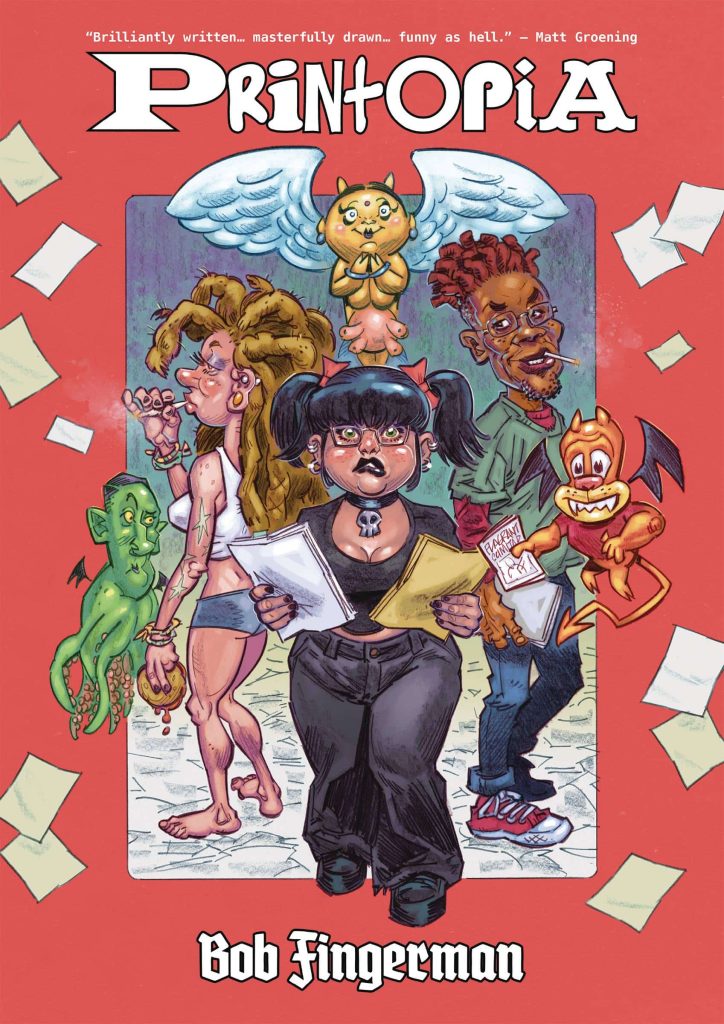
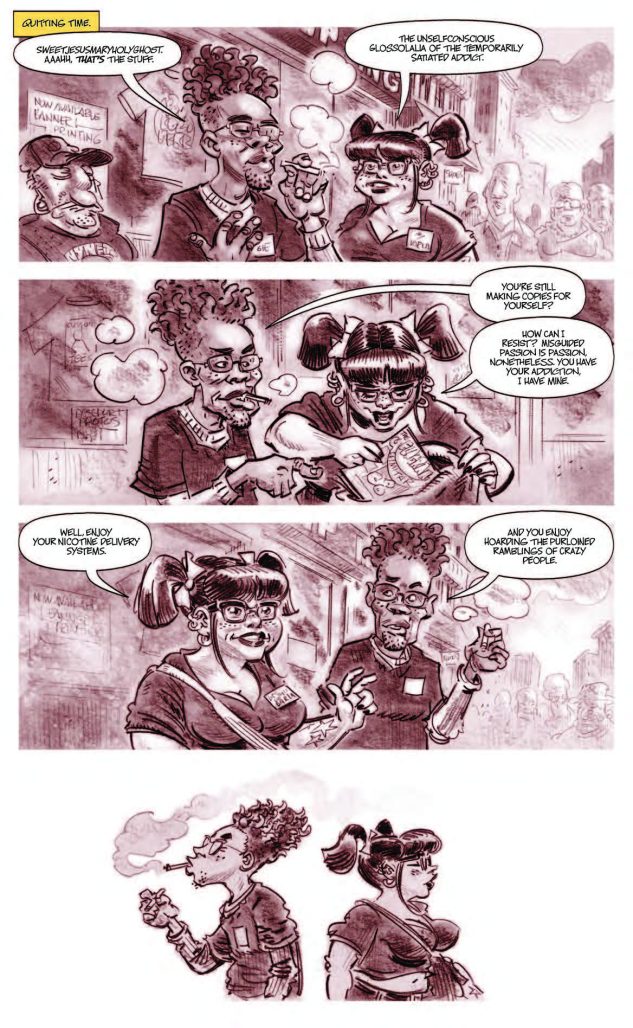
We’re introduced to Darla, employed in a New York print shop where the customer base is heavily weighted toward deluded types believing themselves to be creatively unique. Darla recognises their self-deception, keeping her own copies of their most preposterous output. She’s an unattainable object of desire for some customers, and a blank slate to be educated to others, while harbouring her own ambitions of creative escape.
Darla is well developed, but then sunk in the morass of her supporting cast. She interacts with them delivering clever sitcom lines, but without there ever being a feeling of Printopia leading anywhere further than more clever dialogue. The assorted customers are accompanied by their own inner demons who’re literally rendered, and it gradually drops into place that Printopia is Fingerman’s vessel for satirising assorted New York types, which has a long tradition. He has a good ear for up to the minute terminology and labelling, but six page sequences at a time grind the jokes into the ground, while also providing venues for Fingerman to moan at length about H.P. Lovecraft’s appalling views. There’s a clever revelation about these spotlights toward the end, which drags Darla further into the limelight than presumed, but they still lack spark.
Fingerman is a caricaturist at heart, and delivers his people so well you’d swear you could smell them, and not just those surrounded by a halo of flies. They’re admirably glamour-free and of varied body types, and appear in detailed panels in which the influence of Jack Davis shines through. The icing on the cake is Fingerman’s virtuosity, both writing and drawing the bonus material, which purports to be samples of what Darla has accumulated from her customers’ print orders. They reveal the peculiarities far more compactly than the earlier sequences.
Printopia ultimately seems to be Fingerman exorcising his own demons concerning tiresome fanatics, but less would have been more.