Review by Ian Keogh
French collaborators Philippe Paringaux and Jacques Loustal were among the earliest European creators to have their graphic novels translated into English. This 1990 album followed the acclaimed Love Shots, although was actually published two years beforehand in France.
In one sense it’s more of the same, being largely a very individual and stylised view of the USA as seen by outsiders. Paringaux and Loustal absorb the sense of American disillusion via novels and films and serve it back attuned to the zeitgeist in impressionistic form. Only the final story exceeds six pages, and many only occupy half that, yet it’s enough to convey brief fragments of lives, nearly all disappointing and some on the verge of ending.
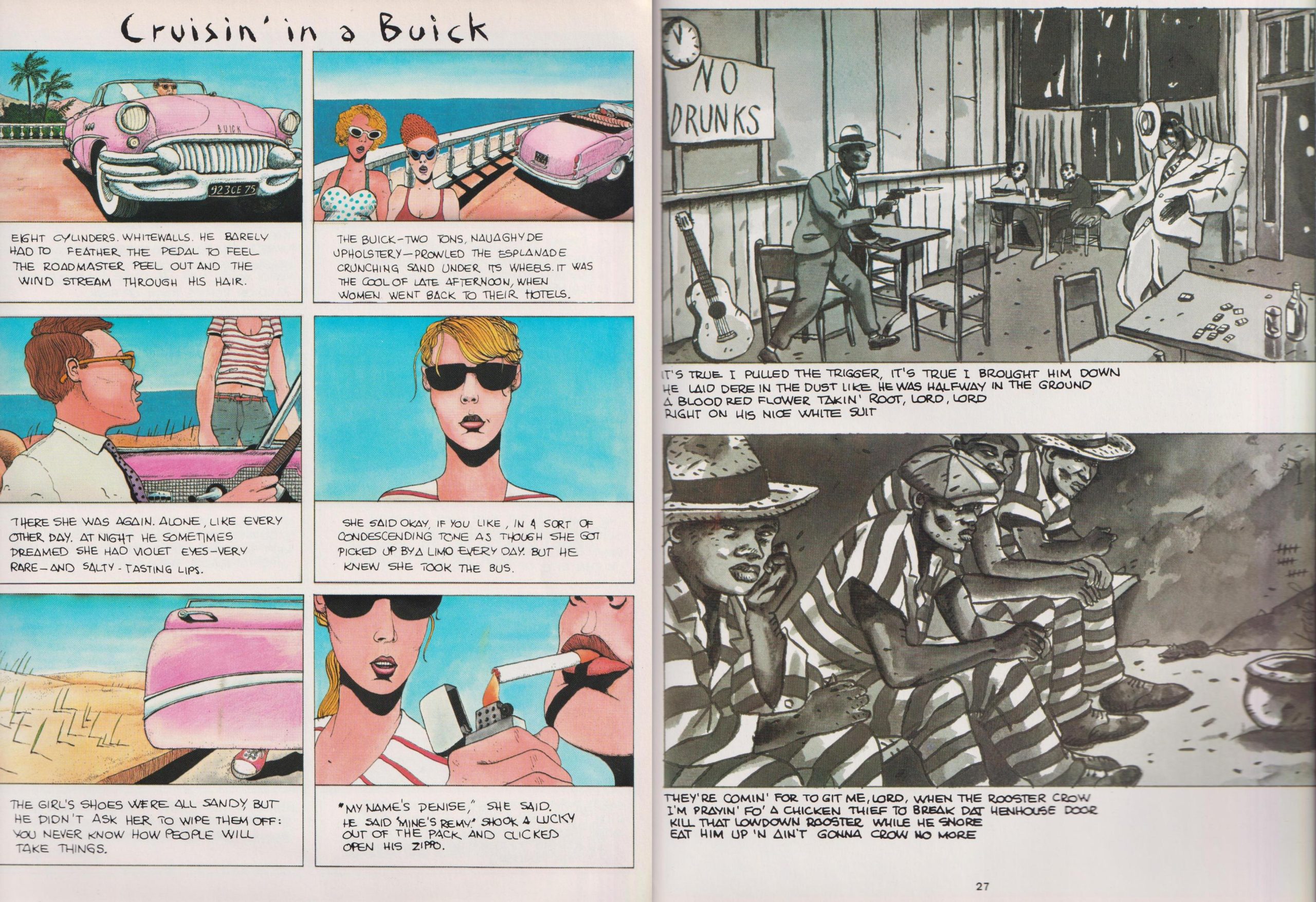
Variety is constant. Loustal draws almost every strip in a different style, some drenched in black ink, some restricted to showing what the narrator sees, others featuring the narrator, one in black and white, another in pastels and all characterised by seediness. His people are exaggerated, flawed and utterly distinctive, all in carefully cultivated surroundings, with greater detail than first seems to be the case. There are no dialogue balloons. The text is in panels appended to the art or beneath it, meaning more space to appreciate Loustal’s unique stylised visions.
Paringaux’s contributions are equally diverse, ranging from the deluded fantasies of a teenage would-be groupie to the suicidal ennui of a big game hunter, and closing with an extended visit back to Spain of 1930s Civil War veteran. The tone differs also, from the comedy of a furtive encounter in a motel to two blues song pastiches for which translator Elizabeth Bell should be greatly credited for the English versions. ‘Blues’ is one of the weaker strips here, but ‘La Vie en Blues’, the title a clever nod to Edith Piaf’s famous ‘La Vie en Rose’, is a powerhouse piece. What connects almost everything is the distanced, objective tone where emotion is suppressed verbally even if the illustrations show different. People are guarded and their feelings hidden. Well, apart from the open wounds of two gay hitmen.
The title strip typifies the style. We’re introduced to someone who travels between New York and Miami on what seems to be shady business, but it’s cleverly written to encourage readers to fill in the gaps themselves. The narrator gives brief observations as to his surroundings, perhaps using a recording machine, yet his purpose is never clear.
For all the progress in the quality of graphic novels over the past decades, New York/Miami remains a unique album venturing into territory largely avoided since. For that reason alone second hand copies would be desirable, but this is also quality that stands the test of time from creators with a very individual worldview.