Review by Frank Plowright
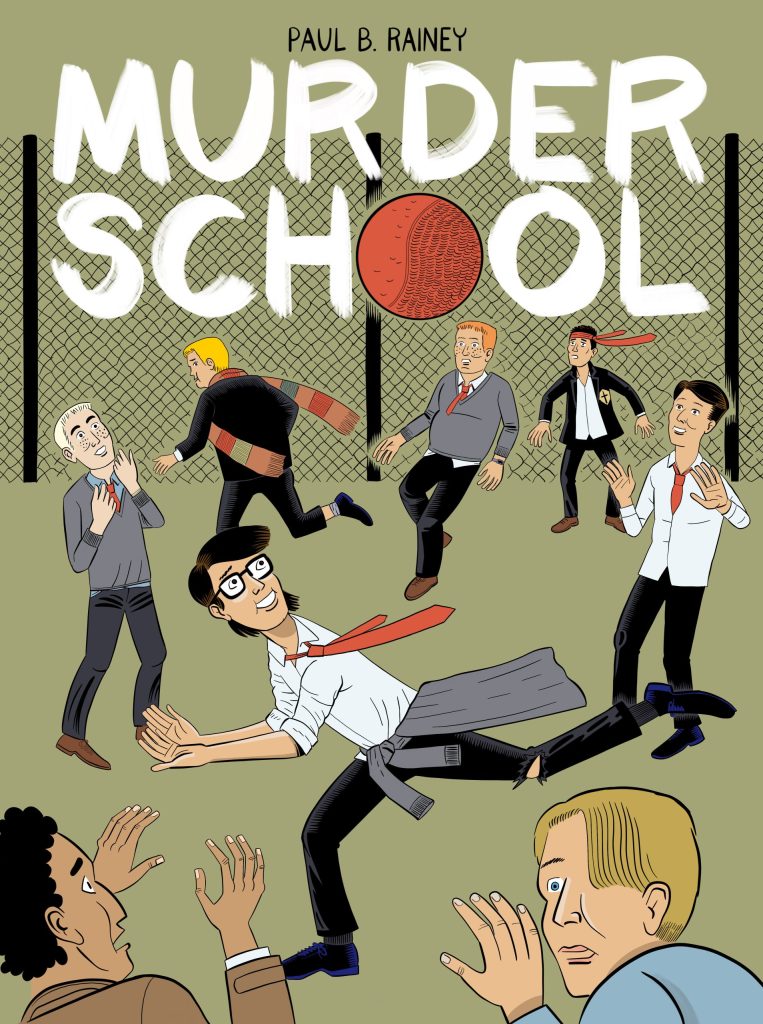
An often repeated adage would have it that one’s school days are the happiest of one’s life. Mere seconds of rational thought disprove that except for those whose school career was atop the power pyramid, yet who ended up working on the local factory assembly line. In Murder School Paul B. Rainey remembers his earliest days at secondary school with a startling precision, recalling the ducking and diving to evade sadistic older pupils and sadistic teachers. British readers who attended Catholic schools during the 1970s and 1980s will find themselves back in the familiar territory of the strap, the ruler, the slipper and the casually flung blackboard duster.
Rainey navigates brutal older kids and teachers unfit for purpose, attempting to avoid beatings from either, all the while cultivating an interest in comics. There must be a solid satisfaction noting the contempt his interest occasionally received balanced against the successful career the interest generated. Because Rainey does largely avoid trouble, with the caveat noted below, it’s the detail that’s so compelling.
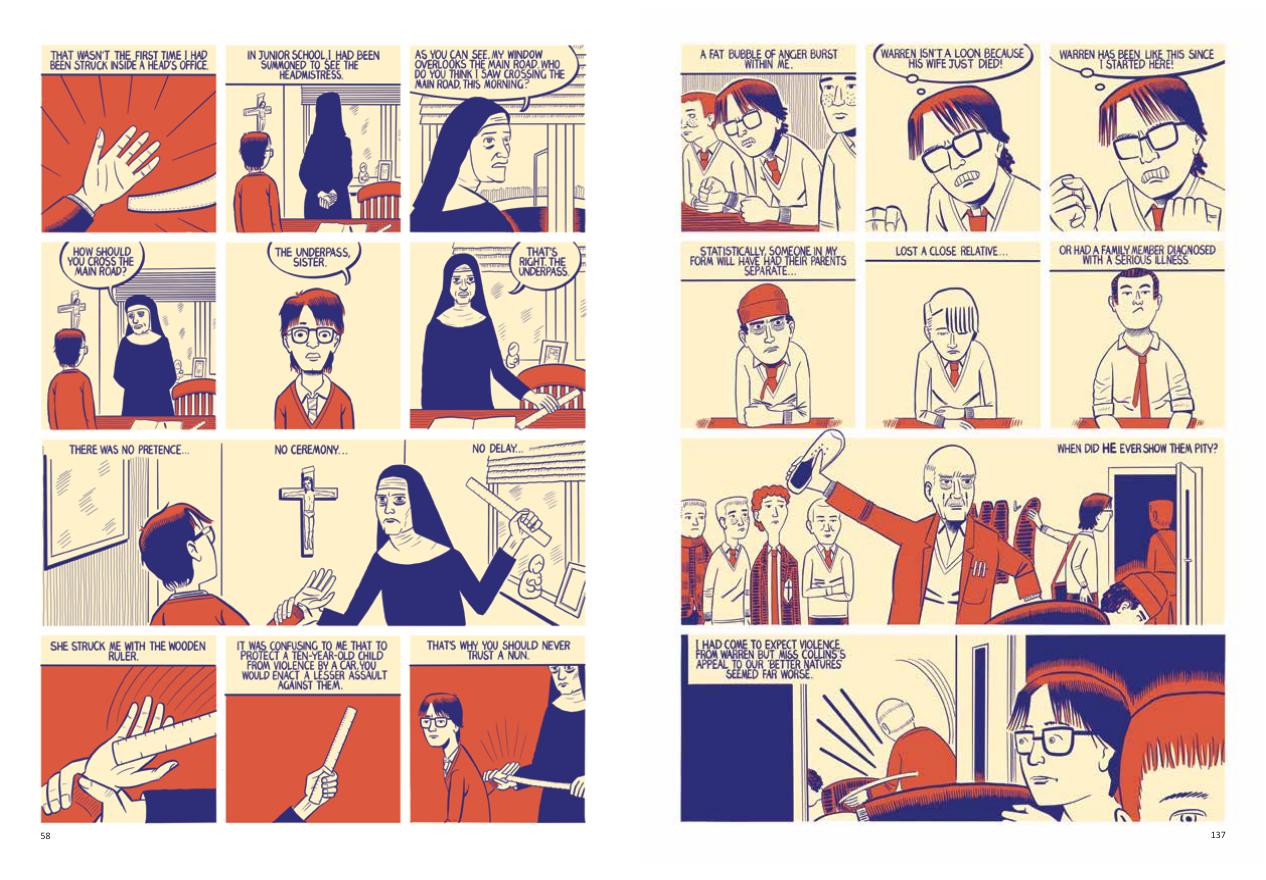
Neat illustration in blue and red on cream brings to mind the British boys’ comics of the era depicted, Rainey and his fellow pupils presented in school uniforms each attempts to wear as untidily as possible. At times artistic repetition signifies the tedium of a school day, while in other places, such as the testing of a supposedly indestructible ruler, it’s for emphasis, and small, lovingly recreated covers of American comics are notable.
However, Murder School begins not with the genially conveyed recollections, but with harsher strips under the ‘Murder School’ title. These are in black and white, credited to “Nick Goddard” and supplied as if fanzines created post-school. The atrocities may require a trigger warning, and while Rainey distances himself from them as personal recollections, they’re certainly incidents widely experienced by British school children who suffered in silence. Decades of interventions, policies and studies have done little to alleviate the life of the child bullied at school.
A second set of ‘Murder School’ strips toward the end drop the Nick Goddard alias and concern Rainey himself searching for an ending to the book. It only momentarily seems too self-indulgent, because a seemingly random chain of circumstance provides the ideal conclusion. It’s smart whether fact or fiction, and if the pay-off at the end is predictable, little else is.
There might be a thought that British school days of the 1970s is somewhat the niche subject for an international audience, yet the past is another country. Hundreds of thousands of boys experienced similar educations, yet what’s laid out here as positively mundane and acceptable for the times has been rendered astonishing in some respects. The sadism of one teacher in particular is highlighted, and as Rainey notes, nowadays he’d be in prison, not teaching. If you thought 1980s schooling was The Breakfast Club and Ferris Bueller, the British reality is a jaw-dropping contrast.