

Review by Ian Keogh
Stan Lee’s writing of the Hulk’s solo adventures was sporadic during 1968 and this is the period where he hands the series over to Roy Thomas, but all but the final two stories are Lee’s extended farewell run.
As with other series where he wound down his writing in the late 1960s, Lee’s later writing isn’t what he’d be remembered for. An indication of his time being occupied elsewhere is nearly all the soap opera being discarded for non-stop action, which is easier to write, and while there’s an energy rush, Lee leaps from one plot to the next with no great regard for anything other than filling the pages. The shock death of Bruce Banner ending Volume 4 is rapidly reversed by alien technology and we move from aliens wanting to subjugate the Earth to the discovery of them also in thrall to a ruler. Stories repeatedly end with Banner endangered when any reader can predict transforming to the Hulk will be the solution.
Lee then seems to remember the Mandarin has previously fought the Hulk, but not what the assorted rings he wears can do, and for no good reason the Mandarin feels Sandman will be a good ally. One has to admire the audacious way Lee deals with the Leader’s presumed death, and it’s an indication of what’s the best story here, in part due to the return of a supporting cast and their dramas. Over three parts the Hulk again connects with Thunderbolt and Betty Ross, while they’re hoodwinked by the Leader who intends to use the military base for his own purposes.
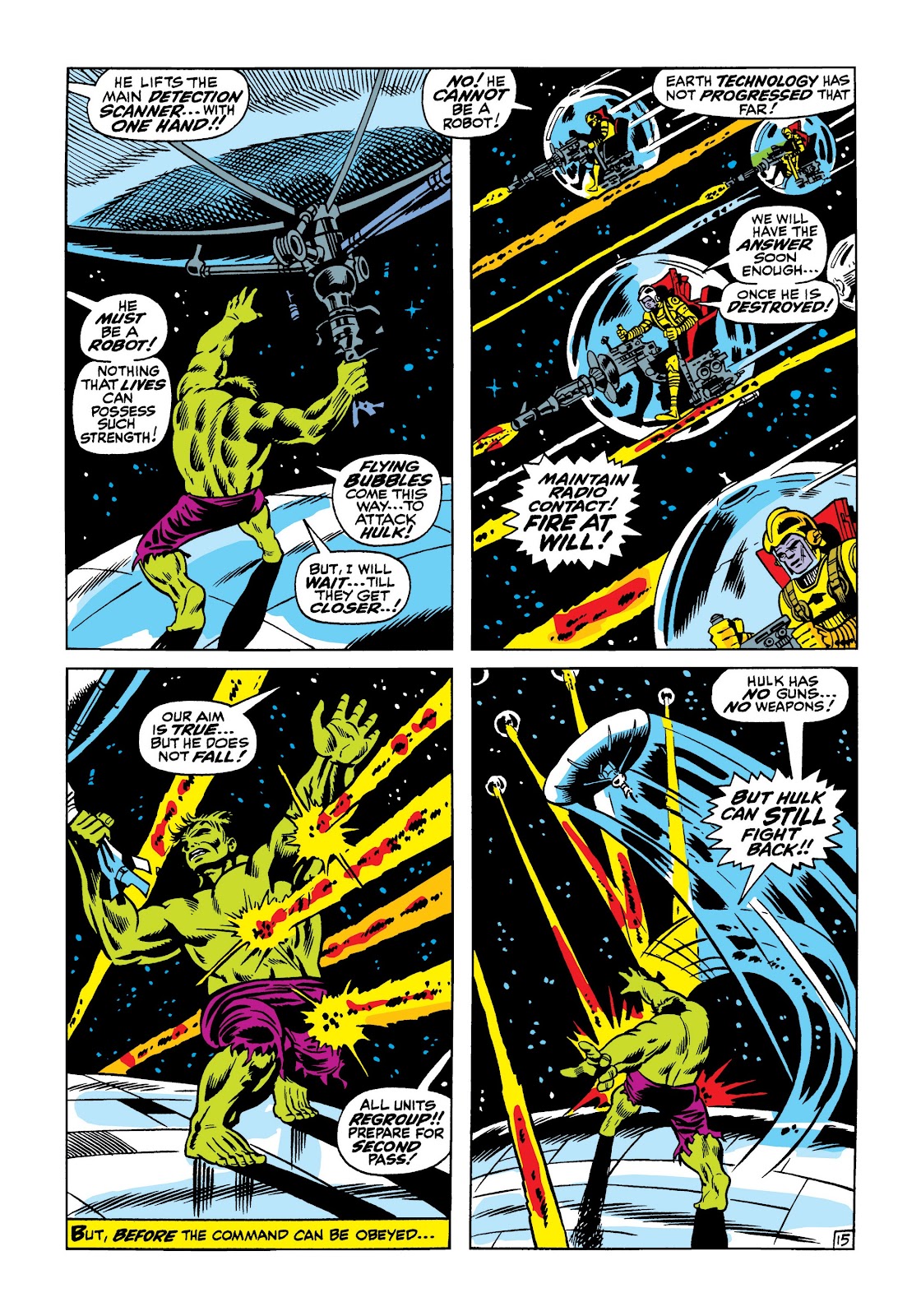
In his introduction Herb Trimpe bemoans the quality of his art, noting the poor figurework and that he rarely draws any eyes, yet these are better pages than his earlier work. Trimpe has rapidly learned how to lay out his stories for maximum visual impact, and that compensates for the anatomical deficiencies.
They’re on show more than usual when the Hulk takes on the Sub-Mariner for the second time, what with both characters only wearing trunks. This is a spirited story, though, and Trimpe delivers the power of two of the world’s mightiest beings clashing when neither is at a disadvantage.
The transition from Lee to Thomas is via Maximus for once menacing the outside world, accompanied by the rag tag Inhuman renegades seen in the previous volume. There’s a reason they’ve so rarely been seen since 1969, and this is Lee departing with a whimper.
Trimpe manages some decorative pages on the closing story, which is Thomas’ proper début as opposed to filling in, and it’s his best Hulk story to this point. His influence is the swamp monster comics of the 1940s, but he twists the concept well to suit the Hulk providing a story that’s atmospheric and emotionally strong.
This is barely better than the previous volume, but Thomas’ strong closer gives hope for Volume 6. This material is also available in black and white as Essential Incredible Hulk Vol. 2.


