Review by Ian Keogh
War Games supplies the entirety of John Byrne’s time writing Iron Man, which is more than earlier paperbacks Armor Wars II and Dragon Seed Saga did.
Three main plots are covered over what was a twenty issue run, and if you feel that speaks to them being over-extended, you’d be right. The first concerns a spinal implant enabling Tony Stark to walk again also being used to control his body remotely. Much of this plot is repetitive, and there’s the ultimate frustration of the primary villain’s motivations never being clarified. Byrne also seems more interested in setting up the next big plot featuring the Mandarin, who’s given considerable space as James Rhodey attempts to figure out why Stark is blacking out.
What makes these chapters the best of War Games is John Romita Jr’s imaginative and occasionally abstract art. The storytelling is absolutely clear, but Romita is a restless artist looking for new ways to refresh an old strip. Paul Ryan drawing most of the remainder has nowhere near Romita’s creativity and his Iron Man is stiff and drawn with an awkward mask.
The second main plot sees the Mandarin come to the fore, only to be immediately sidelined by his ally. It involves the dragon Fin Fang Foom and features Byrne cleverly explaining the Mandarin’s origin, but considering the Mandarin’s USP has always been ten rings each with a different power, they’re barely used. However, Byrne does add considerable depth to the Mandarin’s character and removes him from the stereotypical villain he’d been in the past.
This is partially via three chapters not included in previous collections looking back at both Iron Man and the Mandarin’s past, the first of them benefiting from Ryan’s best series art. It’s a clever reconfiguring and updating of Iron Man’s origin, showing the Mandarin as already in possession of his powerful rings and more entwined with Tony Stark’s captors than previously known. Unfortunately, though, that’s if read as three individually connected issues. As part of the longer ‘Dragon Seed Saga’ they only serve to drag it out further.
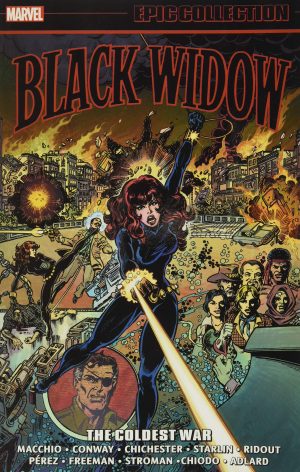
Also missing from previous collections is the two part closer, although Black Widow is given considerable foreshadowing in earlier chapters. She’s extremely concerned about the automatic activation of a former Soviet sleeper agent called Oktober, but no-one she approaches shares her anxiety. Nine pages of set-up are entirely unnecessary, as the story could equally have begun with the Black Widow awakening Tony Stark opening the first of the two previously unreprinted issues. By that time the threat of World War III is apparently only ninety minutes away. There’s a clever twist, and a clever solution, but the remainder is strictly filler.
By the time he came to write Iron Man Byrne’s reputation as his generation’s greatest superhero storyteller was cemented, and leaving him pretty well to his own devices had more than paid off on other projects. Unfortunately, his lasting effect here was to trail the endlessly decompressed superhero stories of the early 21st century.
If you’re following Iron Man continuity, the next Epic Collection is The Return of Tony Stark.