Review by Ian Keogh
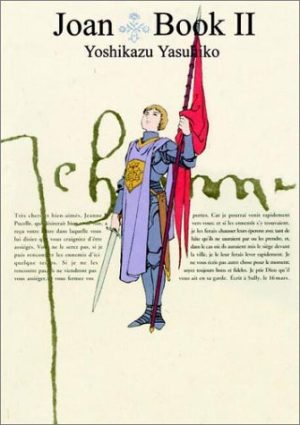
Joan takes place in the mid-fifteenth century France, which immediately brings Joan of Arc to mind, but Yoshikazu Yasuhiko’s tale concerns a different Joan, slightly younger, but equally passionate.
She’s the daughter of a dead nobleman whose wife purged his second family, so for protection she’s lived as the son of her father’s former servant. At seventeen she has the opportunity to renounce her secrets, but instead chooses to remain as Emil and intervene in the complex political conflicts in France. Emil/Joan has some form of psychic ability. It enabled her to see the visit of Joan of Arc to her home, even though this occurred three years before her move there, and there’s a second, more decisive meeting. Emil’s task becomes to seek out King Charles VII and protect him, and ultimately to continue Joan’s mission of driving the English from France.
Very unusually for a Japanese series Joan is entirely in colour, and the delicacy of Yasuhiko’s art sometimes disappears within the bright yellow watercolour shades he’s so fond of. Other pages have a greater subtlety, and the blue toned beauty of Joan standing in snowy countryside really transmits. She’s drawn as beautiful, but androgynous, and there are none of the visual shortcuts usually associated with manga as Yasuhiko lets the illustrations tell the story. A standout visual sequence is a chase on horseback through a winter forest.
Emil associates with soldiers who’d known Joan and follows a route she’s known to have taken. Readers may feel she’s too trusting. That certainly has consequences as the background of nobles constantly scheming against each other is complex. At times Yasuhiko explains too much, and at others too little, while asterisks lead to information at the back of the volume that might have better been given on the individual pages.
By the end of Book I Emil has suffered through a long dark night of the soul and taken a leap of faith leading to Book II.