Review by Ian Keogh
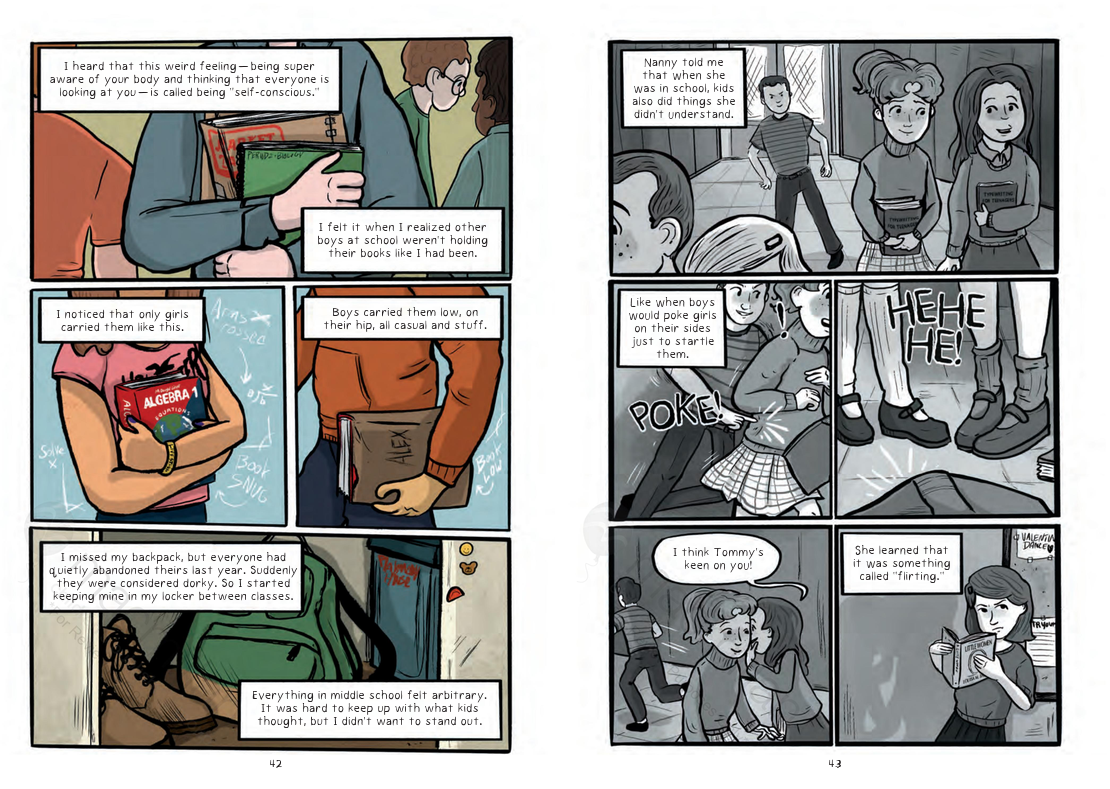
In Hand-Me-Down Damian Alexander contrasts loss and alienation as experienced by two different generations in different eras. Alexander’s mother died when he was two, leaving him and his slightly older brother to be brought up by their grandmother, whom they call Nanny. She also had a deprived upbringing, shunted from one foster home to the next along with her two sisters, and Alexander details his own feelings of isolation and speculates from the stories she told how his grandmother’s experience mirrors his.
As Alexander’s aiming at younger readers he’s more likely to strike a chord with his personal, introspective recollections of low self-esteem. Children may recognise themselves in his avatar, whereas for a long way through the book adults are likely to consider it’s only the telling that differentiates Alexander’s memories from those of countless others.
Simple cartooning implants the younger Alexander in his world, switching to black and white to indicate his grandmother’s experiences being further in the past. It’s expressive and clear, but no more, although that’s enough to transmit what’s required.
Alexander’s able to recall his teenage feelings with clarity, but the constant self-reflection is wearing. It’s only toward the end of Hand-Me-Down that Alexander’s own past takes a more dramatic turn as he creates an imaginary friendship with his mother. It’s finally something not found in other memoirs of lonely children, and a key to his loneliness. For a long while it seems the vacancy for an idealised mother is completely blinding Alexander to reality, but thankfully there is a lightbulb moment of him realising the effort his grandmother made.
A similar lightbulb moment never occurred in realising Alexander himself wasn’t the best subject for Hand-Me-Down. When attention turns to Nanny it becomes more engaging. Her story both as a child and an adult has greater tragedy, yet the details are often only mentioned in passing and her experiences only occupy around a quarter of the book. It’s a missed opportunity.