Review by Frank Plowright
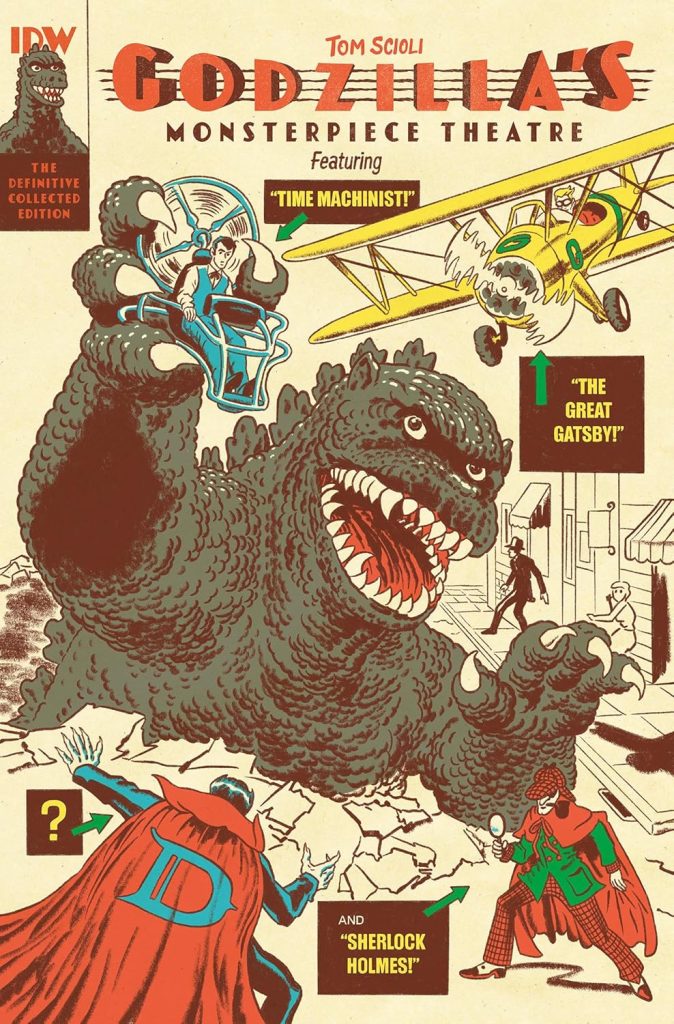
Tom Scioli has to be given credit for an original turn of mind. There can’t be many, if any, other creators who’d consider Jay Gatsby an ideal sparring partner for Godzilla, yet Monsterpiece Theater takes the preposterous joke, runs with it, and brings it home all the way from the excellent Fantastic Four pastiche on the cover. Making sense of it all, though, does really require having some idea of what The Great Gatsby is all about as Scioli starts with a contracted version that might transmit as so much nonsense otherwise, and characters such as Nick will seem to have no purpose.
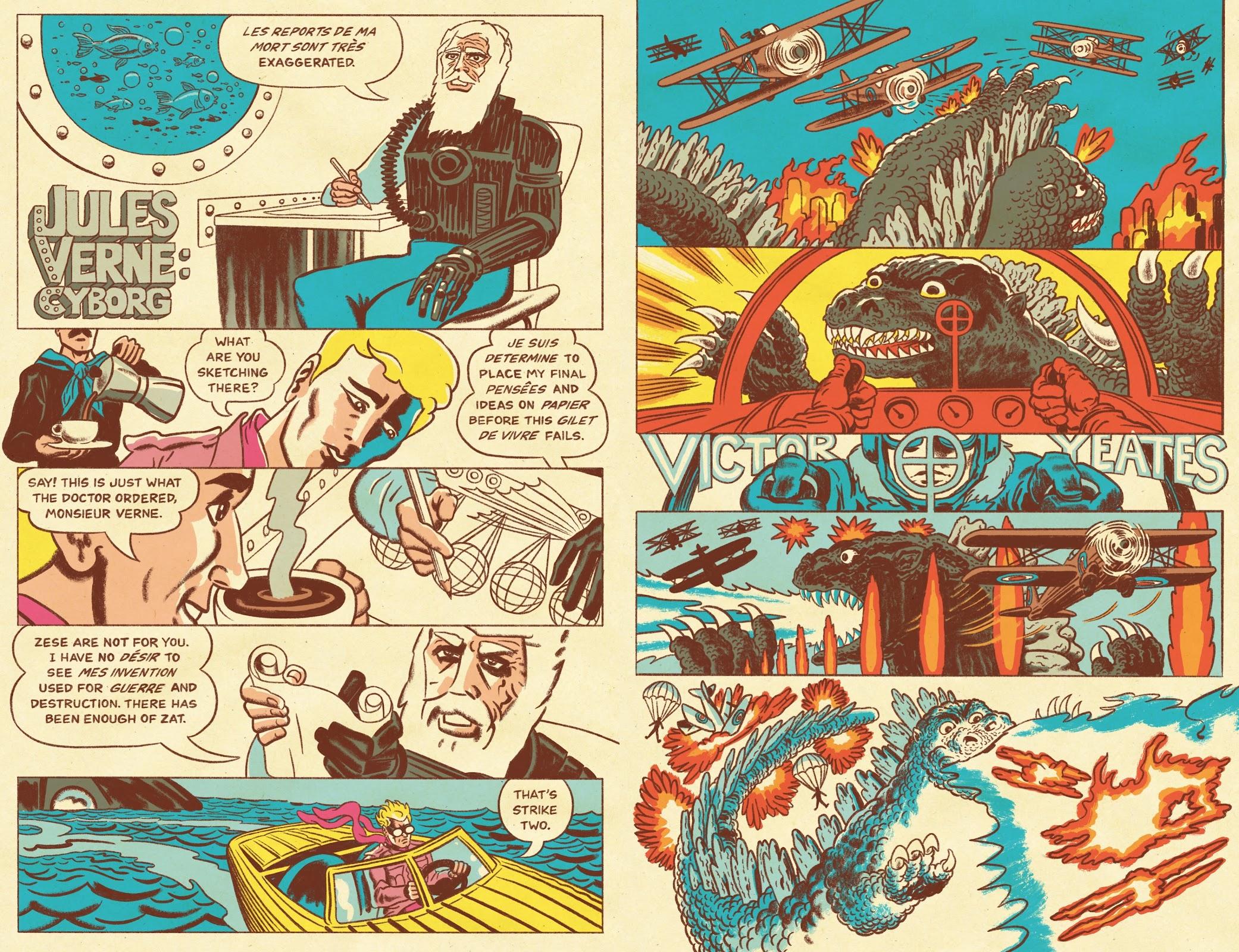
However, it’s a well written pastiche, transmitting Gatsby’s isolation and longing staring at the house across the bay, but now lurking in Long Island Sound is Godzilla. In Scioli’s story it’s the resuscitation of Gatsby, giving him pride and purpose as he consults other celebrities of the era, funding a way to deal with Godzilla. Scioli succeeds in an imitation of the novel’s tone, and his wonky art supplies a notably good version of Godzilla amid period detail.
For all the fun on offer, it seems as if the idea of Gatsby funding and heading a response team he calls the G-Force is going to run out of steam, but Scioli’s aware enough to recognise that, and it’s when he begins introducing others from the 1920s. They’re a mixture of fictional celebrities and genuine historical figures, such as the modified Jules Verne on the sample art with his distinctive cyborg body and Franglais speech. There’s an even funnier joke about accents on the following page set in London and featuring a chimney sweep. Multiple other smart passing references appear. Look, for instance, for a yellow submarine.
Scioli relishes Godzilla destroying the world’s major landmarks, which is gleefully presented. Whether Scioli’s art will appeal to the elite Godzilla fan is questionable. It’s good, but perhaps too stylistically individual to become a universal pleasure, yet over recent years the interpretation of Godzilla has moved away considerably from tradition and poor results have rarely manifested under IDW’s watch.
The same applies to Dracula, and he tips up halfway through, again a departure from the familiar, here in red cloak and top hat, although otherwise almost satanic, and proves instrumental in moving the plot forward. Again Scioli proves an astute storyteller as he introduces Dracula at exactly the point the plot needs freshened.
A gleeful absurdity prevails throughout yet the strength is evident via a story that would work if given an entirely straight treatment. Never ceasing to throw in period references, the culmination is a great joke playing on the source material’s title. It’s a joy, an absolute joy.