
Review by Lewis Savarese
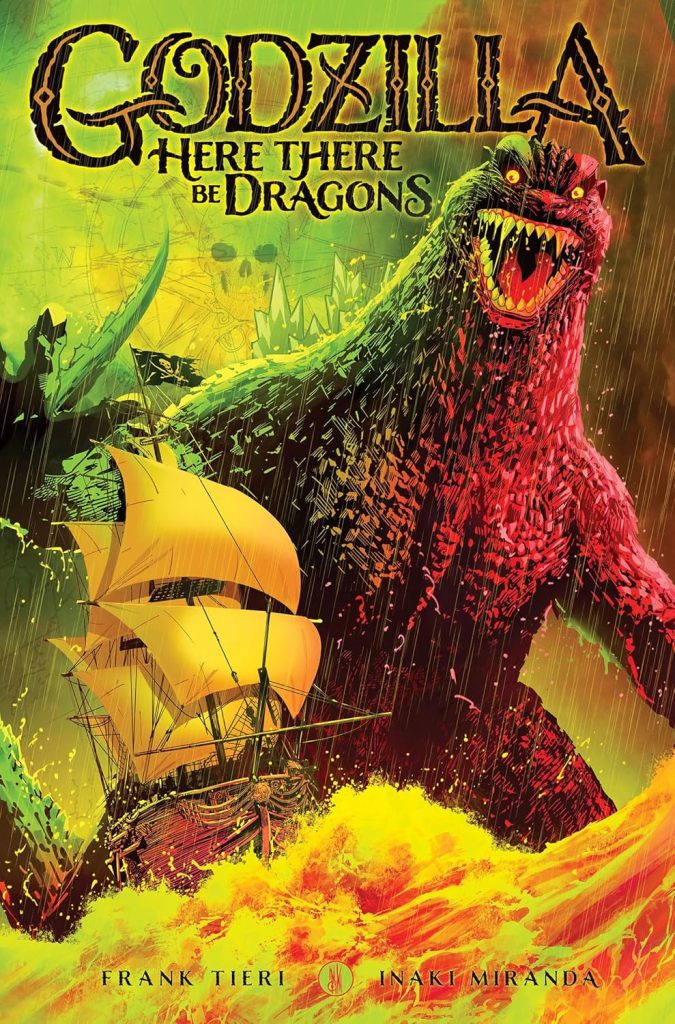
Godzilla aficionados and casual kaiju fans alike are familiar with the King of the Monsters’ mid-century origin story: underwater hydrogen bomb testing conducted by the United States military in the South Pacific disturbed and irradiated a colossal, prehistoric beast. In Here There Be Dragons, Frank Tieri and Inaki Miranda insert Godzilla into a fantastical account of the 16th century explorer and privateer Sir Francis Drake’s circumnavigation of the globe, eschewing any hint of time travel as a justification for the presence of the atomic titan. This historical Godzilla tale (or ahistorical depending on your perspective) is not as novel as it sounds, considering 2016’s Rage Across Time covered similar ground. However, the story’s intrigue extends beyond setting and the title’s clever reference to the 16th century cartographic practice of marking uncharted waters with the Latin phrase hic sunt dracones, “here be dragons”. Tieri’s inclusion of an ancient cult lurking in the shadows and Miranda’s art make for a worthy take on the Godzilla mythos.
Our initial introduction to the world is via the yarn of fictitious pirate Henry Hull on the day of his execution. Hull recounts to his jailers his time in Drake’s service aboard the Golden Hind galleon on a voyage sponsored by Queen Elizabeth I. Tieri’s retelling of Drake’s journey departs drastically from the historical record as the Queen entrusts Drake not with the raiding of Spanish colonies, but instead the recovery of lost treasure from Monster Island. The frame story occasionally stifles the narrative’s momentum, taking you away from Miranda’s deftly rendered pages of naval warfare, kaiju attacks, and swashbuckling. Still, we are invested in Hull’s fate through his colourful narration of events and their increasing stakes. The most notable escalation comes when Hull reveals to his captors the existence of the Sons of Giants, a secret society that worships and protects kaiju.
Miranda is able to navigate the expository nature of Hull’s portion of the story with unique page layouts and striking images. At the first mention of the Sons of Giants he provides an eerie tableau of robed figures adorned with golden kaiju masks in what appears to be a darkly-lit temple. For those Godzilla fans more interested in kaiju action than historical conspiracies, Miranda delivers.
Early on Godzilla lays siege to the entirety of the Spanish Armada utilising claws, tail, and atomic breath. However, some fans might be disappointed with the two marine kaiju which Tieri enlists to antagonise Godzilla and Drake’s crew, even if they are admittedly story-appropriate. Save for a single spread of A-list kaiju (Mothra, King Ghidorah, Hedorah, Rodan) rampaging throughout human history, Ebirah the giant lobster and Oodako the giant octopus are the main heavies. Tieri and Miranda commit an ample page count to the knock-down, drag-out fight between the three leviathans, which includes dismemberment, strangulation, and an unconventional finishing move. Miranda’s interpretation of Godzilla shines, with inspiration drawn from the Millennium era Godzilla: Final Wars film, and a subtle purple hue courtesy of colourist Eva de la Cruz.
As the narrative wraps up, Hull’s story and predicament reach their gripping conclusion while the Sons of Giants’ machinations expand. We are left with a cliffhanger that is further explored in Godzilla: Here There Be Dragons II―Sons of Giants.