Review by Andy Williams
Back in 1961, Stan Lee and Jack Kirby launched Marvel Comics with The Fantastic Four: a quartet of intrepid explorers who blasted off into space, returning to Earth imbued with super-powers. This team were very different to the “super-friends” seen in other comics. They bickered and argued like a family and had “real” issues to contend with, spawning a whole universe of “troubled” heroes with relatable problems.
Of course, one of the central conceits of most long-running comic series is the characters not ageing significantly: nobody wants to see a colostomy-bagged crusader on his mobility scooter dealing geriatric justice to an over-the-hill underworld. But what if such characters, created in a more innocent and unenlightened era, were to age along with their readership, similarly affected by world events?
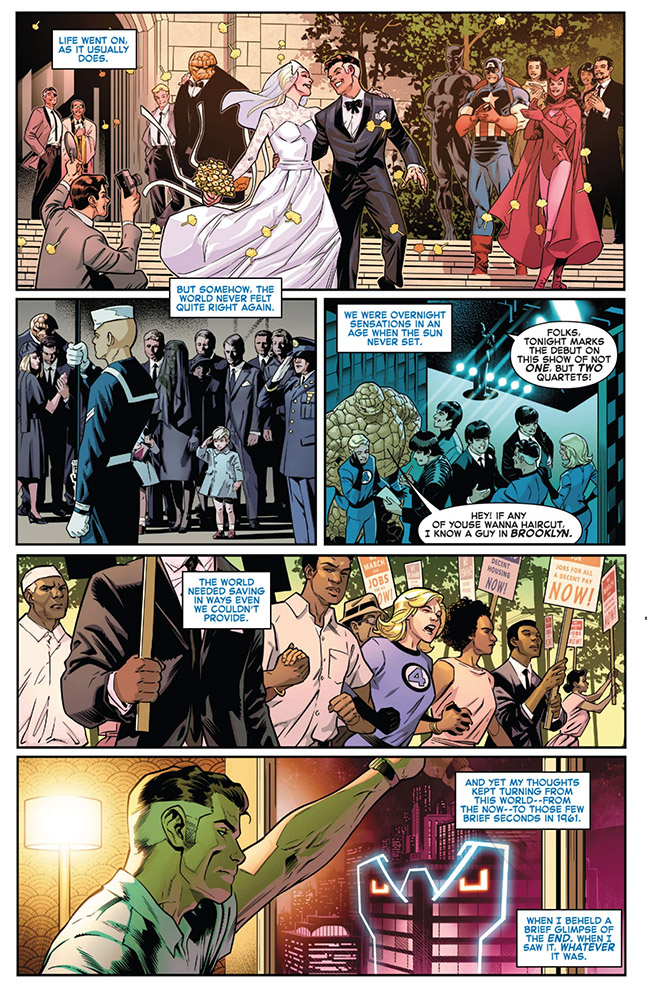
Writer Mark Russell takes Marvel’s “First Family” through a decade in each of the six chapters, from the Cold War Space Race of the 1960’s to the more recent turbulence of the 2010’s. As expected over sixty years, the team and family dynamics change – marriage, death and the birth of a new generation all impact in ways both expected and unexpected.
Team leader Mr. Fantastic, super-stretchy super-scientist Reed Richards, is haunted by visions of cosmic dread and obsesses over them to the detriment of his personal relationships. Invisible Woman Susan Richards tries to hold the team together as wife, mother and sister, but struggles with Reed’s emotional and intellectual distance. Hot-headed teen Johnny Storm matures into his role as the Human Torch, while Ben Grimm’s initial bitterness about becoming the monolithic Thing develops into a strong affection for his friends and family.
Many characters from regular FF history appear (Doctor Doom, Black Panther, Silver Surfer) rubbing shoulders with “real” presidents, scientists and celebrities (John F. Kennedy, Carl Sagan, The Beatles), while touching on “actual” historic moments (civil rights, Vietnam, women’s lib, nuclear brinkmanship), which help to ground the story in “our” world. The over-arching narrative of global obliteration can be seen as a metaphor for the many apocalyptic scenarios that we may visit upon ourselves (climate change, overpopulation, nuclear Armageddon) or indeed, an extra-terrestrial extinction event like the meteor that wiped out the dinosaurs.
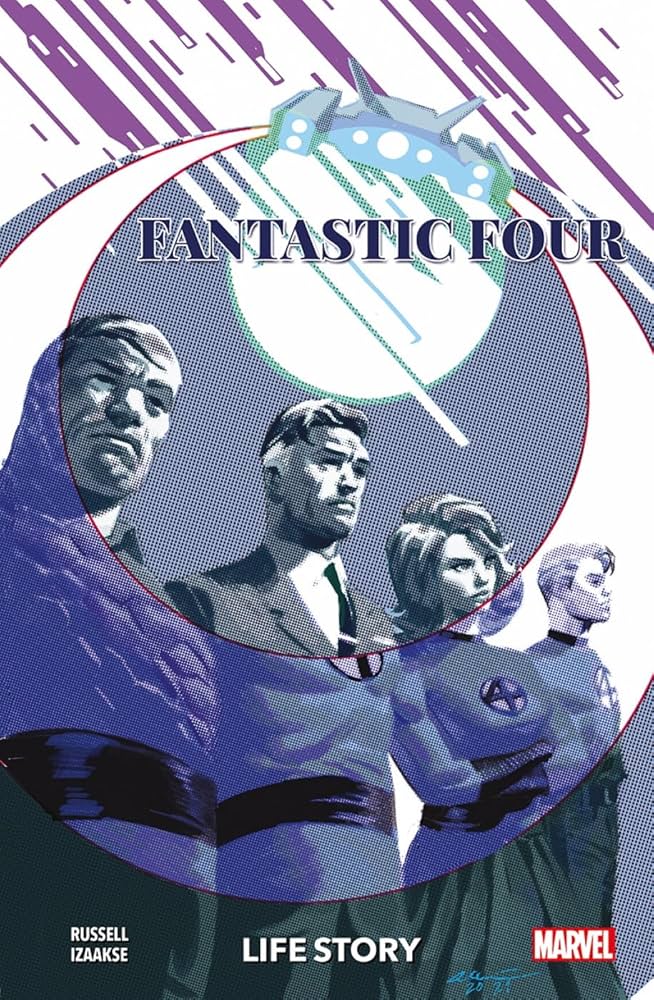
The art in the first half from Sean Izaakse is solid and unflashy, but to be fair, the grounded script doesn’t leave much scope for a spectacular approach. The remaining chapters are inconsistently drawn by Francesco Manna, Carlos Magno, Angel Unzueta and Zé Carlos. The art fails to properly reflect each decade and the project might have worked better with different artists for each chapter evoking the relevant era. All in all, solidly entertaining work from Russell who continues to impress, keeping the focus on the characters in the sprawling narrative. It is however let down by the unadventurous art styles and may have benefited from a more experimental approach, such as on Daniel Acuña’s evocative covers.