Review by Frank Plowright
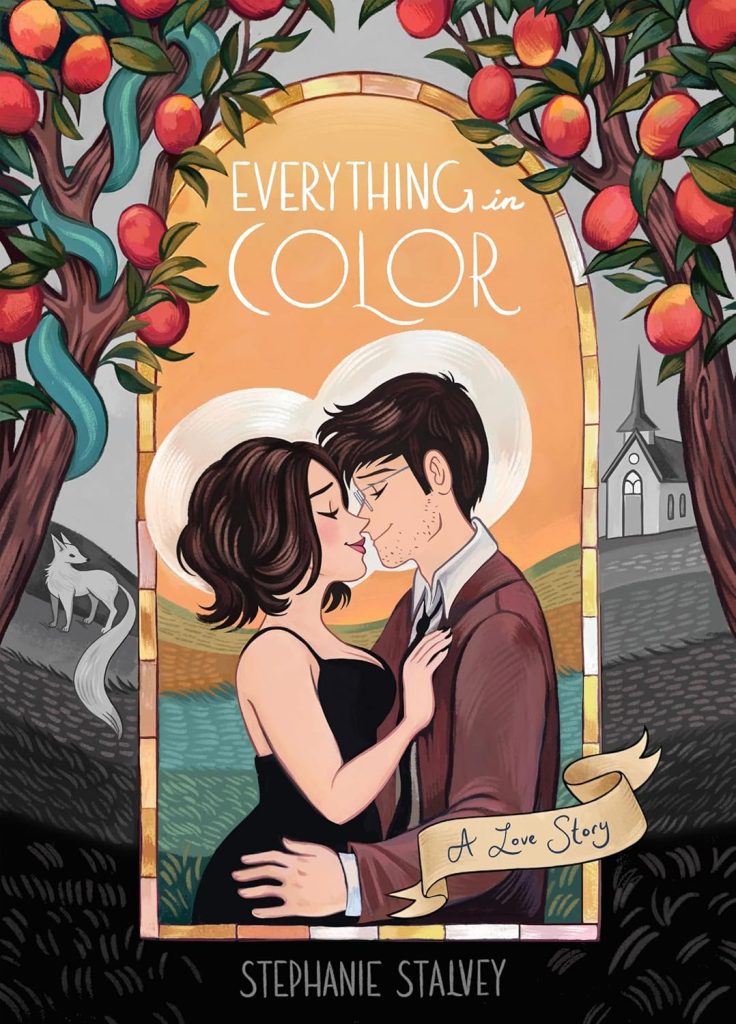
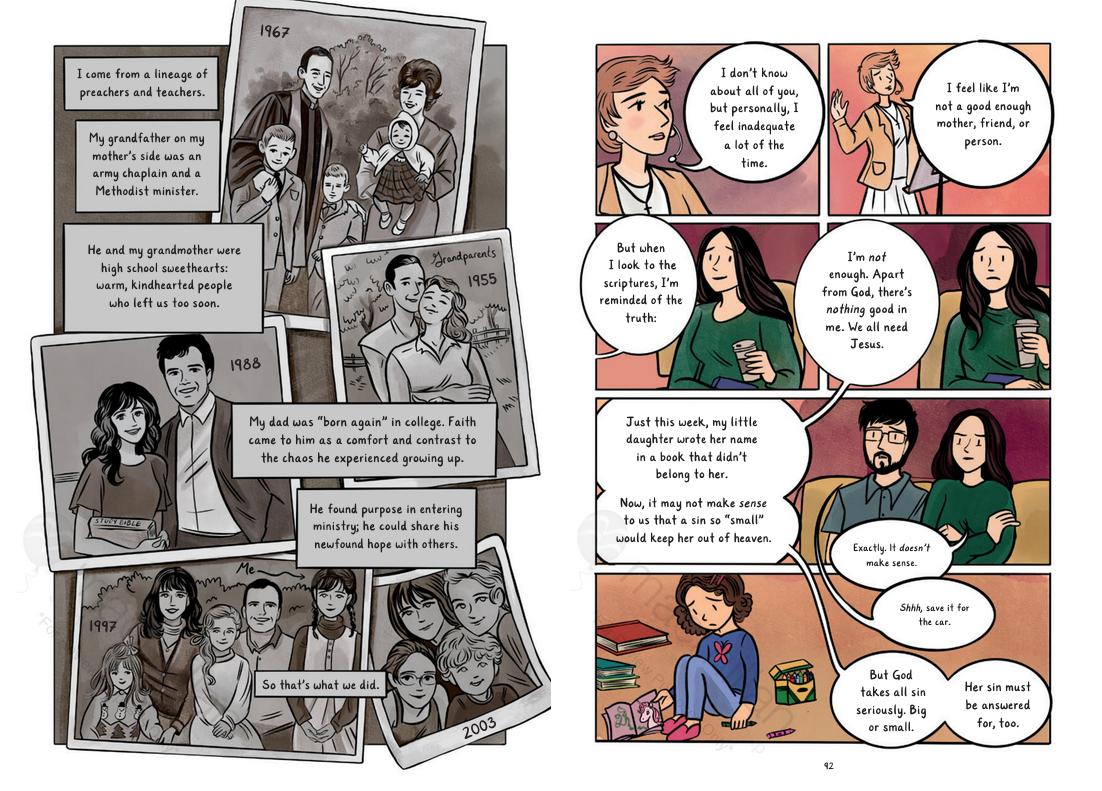
Part autobiography and part personal philosophical treatise, Everything in Color charts Stephanie Stalvey’s journey through the Christian religion that shaped her life until the point she rejected it. A parallel thread concerns her as a new parent ensuring her child’s upbringing is different. The title comes from the past being presented in grey tones, while the present is painted in full colour for a metaphor that’s a little too obvious.
What’s stressed in her early life is the Christian method of scaring children into good behaviour, either via mention of eternal punishment in the afterlife, or with spankings. When she has her own son, Stalvey’s determined his youth will be devoid of the fears instilled in her, but as has been the case for so many idealistic parents, she runs up against a child with a mind of its own.
Skilled illustrative artwork brings everything to life, with religious iconography a frequent accompaniment, echoing the style of adorational paintings. The standard neat cartooning conveys feeling and tension extremely well, that tension originating from the internal battle between prescriptive religious upbringing and natural procreative instinct.
Given Stalvey’s upbringing it must be extremely difficult to banish self-doubt, but as attractive as Everything in Color looks, it’s a graphic novel that never escapes moving in circles. Variations on a stock set of scenes occur again and again, while some moments crying out for greater explanation aren’t explored. In a religious context, what on Earth would a spit cup be? Yet discussions about how far is too far never seem abbreviated, played out in full several times when a single example would be enough. Steph and future husband James finally bonding occupies an interminable forty pages, obviously extremely important to them, but not compelling enough for others to take so much space. Stalvey not being attuned to a potential audience is partly why Everything in Color runs over five hundred pages. It’s not as if brevity is an alien concept, and narratively she’s at her best with brief scenes that make a point, such as a spell volunteering with a Christian group in South Africa.
On the positive side, in focussing on religious doubts Everything in Color explores relatively new territory for a graphic novel. Stalvey brings out how so much religious doctrine relies on a perception of God as unknowable, and anyone questioning that is considered putting themselves above God. It’s a line of logic easily dismissed except for those with a strong belief, for whom it’s an irrefutable putdown without a response other than shame.
A tauter examination at half the length would be a stronger book, but repetition relegates Everything in Color to a trial at times.