

Review by Ian Keogh
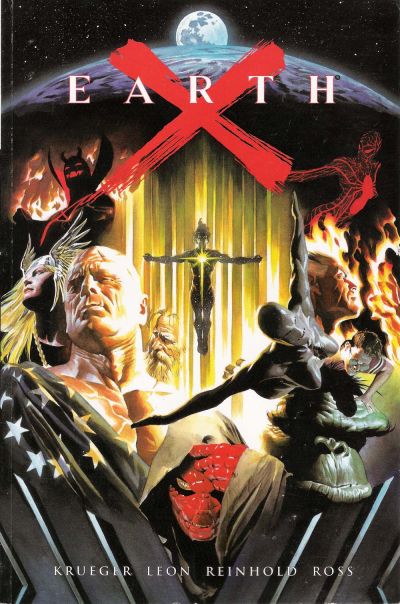
Earth X can’t be faulted for the ambition, beginning with how life and superheroes developed on the mainstream Marvel Earth, latterly considered Earth 616, before moving forward to the future and how it could all possibly end.
The Inhumans return to Earth after an absence long enough for Peter Parker to have become an overweight middle-aged man, but in the meantime things haven’t gone well for New York’s heroes. Many have died, and those who remain are fighting what seems a losing battle against an alien invader that absorbs people into a collective consciousness. This is being observed by X-51, formerly Machine Man, who’s been transported to the Moon by the Watcher, no longer capable of recording Earth’s history. As events play out in the present, X-51 watches the past and discusses the implications and nuances with the Watcher.
Plotted by Alex Ross in the company of Jim Krueger and with Krueger providing the script there’s intelligence, thought and some new ideas about the Marvel characters, but it’s really difficult working a way to them through the endless chatter. The discussion between X-51 and the incapacitated Watcher drones on and on to the point where even extensive caption boxes can’t contain everything and post-chapter continuations are required. As is the case with other collaborations between Ross and Krueger, there’s no ability to distil to the essence, and it makes for dull reading.
Quite a few characters have been redesigned, presumably by Ross, but it’s John Paul Leon responsible for the art. On the right project he’s a phenomenal artist, but is this the right project for him? There is an amazing amount of effort on Leon’s part, and his strength is creating a dark atmosphere, which Earth X certainly requires. However, his layouts and very individual sense of muted characters just don’t make most events look greatly interesting. Reminders of the talent occur with the exceptions. A page of Jack of Hearts flying over a railway station in which old steam trains are waiting is phenomenal, as is his rendition of X-51 throughout and Galactus toward the end, but it’s among too many crowded pages where the focus isn’t obvious.
Earth X was serialised over 1999 and 2000, and proof of the conceptual density is how many ideas subsequently made their way into mainstream stories. Norman Osborn didn’t become President, but a whole crossover was constructed around his being in charge of US security, and there has been a female Thor. Among other really good ideas is the purpose of Galactus, and when we finally reach it, the explanation for why everything’s happened and who’s responsible is also smart, but it takes sooooo long to get there.
Ultimately, the concept is strong, but the treatment fails it. Nevertheless, the multiple cover variations to the graphic novel prove enough people enjoyed this to ensure Earth X remains among the stock Marvel canon, reprinted every few years to ensure it’s always available. It also prompted a pair of sequels, beginning with Paradise X.