Review by Karl Verhoven
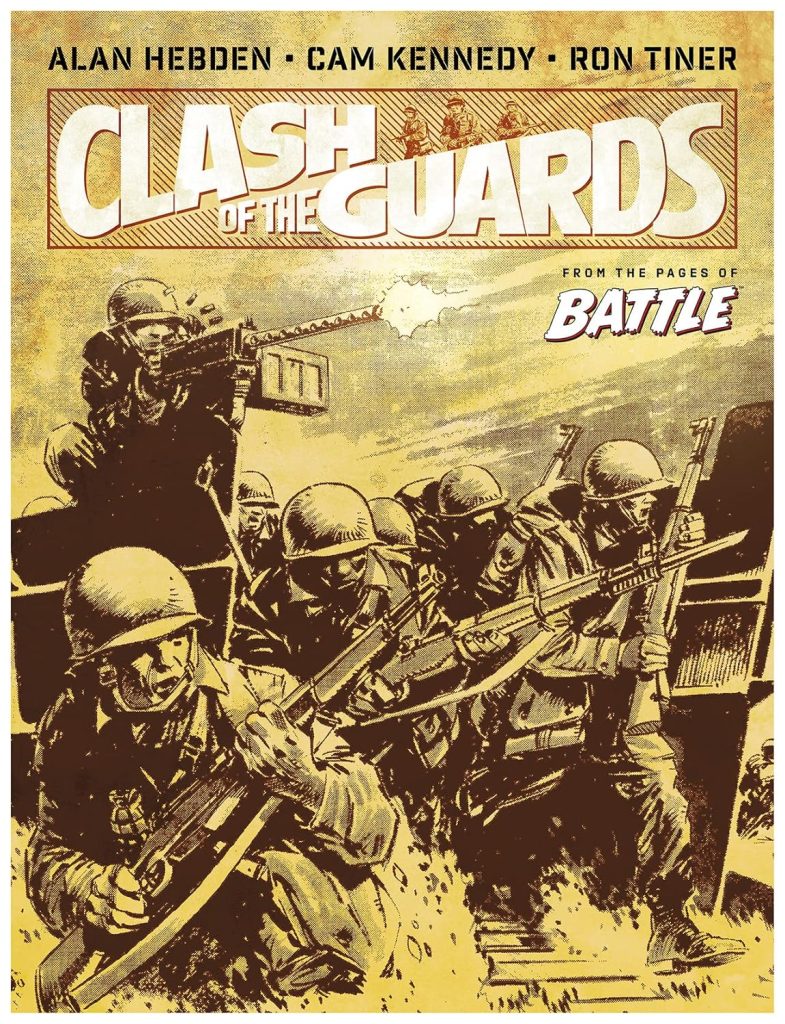
Clash of the Guards is titled after lead character Brad Clash, an American soldier seconded to a British unit as allied forces work their way northwards liberating Italy during World War II. As with the heroes of so many British boys serials from the 1950s onwards, Clash’s name isn’t the only improbable aspect because he’s also a speedway rider and Hollywood stuntman. It paves the way for a succession of daring motorcycle stunts to provide visual spectacle.
As ever in British war comics, even armed with machine guns German troops are incapable of hitting Buckingham Palace from a metre’s distance, so any moving target is well beyond their accuracy levels. It gives Clash licence for havoc whether driving a Jeep or riding his beloved motorcycle. Initial episodes play the brash American against the British stiff upper lip with an early moment of appreciation being “I say, that was splendid stuff Captain Clash! You might turn out to be rather useful to the Guards after all!” However, once he’s exhausted his clipped understatement in the dialogue Alan Hebden decides Clash is better as a solo act.
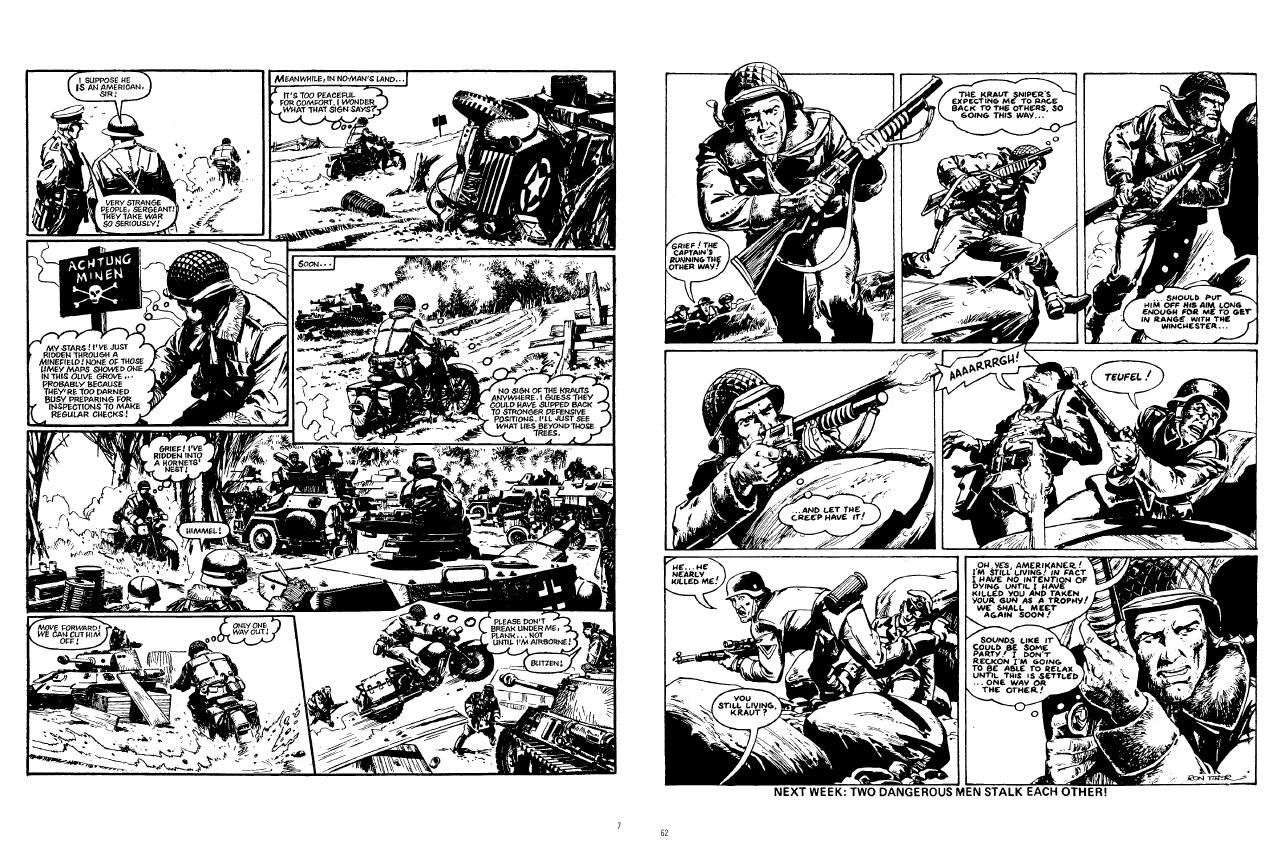
There’s a certain trickery to the three page scripts, but they’re formulaic, but the only real wonder is Cam Kennedy’s art, and that’s why there’s a reprint after all these years. In Paul Trimble’s introduction he notes Kennedy crediting his son’s model kits for the accuracy of the tanks and planes on the page, and they’re notable for the subsequently more impressionistic Kennedy supplying intense detail. He takes a little while to work his way into the feature, with the earlier strips more crowded than what follows, but right from the start there’s a kinetic rush to the action, the faces have personality and as the seasons progress Kennedy depicts the changing conditions from mud to snow. The art is all the more astounding for the amount of small panels needed to tell a story in three pages. Kennedy can really strut his stuff when allocated six pages on a story prepared for an annual.
After the initial dozen or so short stories Hebden involves Clash in longer continuities, starting with helping Italian resistance fighters, but the mainstay remains Germans exclaiming “Achtung”, “Teuful” and most frequently “Aaargh!” as Clash and co. set about them. The best of the longer sequences concerns hunting down snipers, but that’s drawn by Ron Tiner. A mystery surrounds the art transferring from Kennedy to Tiner. The reason given at the time was artwork lost in the post, but that doesn’t account for Kennedy’s supplanting nor Tiner beginning with a new story.
The title feature only occupies two-thirds of the collection, and the remainder is assorted one-off strips Kennedy drew for Battle around the same time showcasing the same dedication. The writers are unknown, but the tone varies from respectful portraits of real life war heroes to the more usual gung-ho fare, all impeccably drawn.
For any fan of Kennedy’s art Clash of the Guards is absolutely essential, but the more casual reader will recognise how greatly it elevates basic scripts, and is unlikely to be as enthusiastic.