Review by Frank Plowright
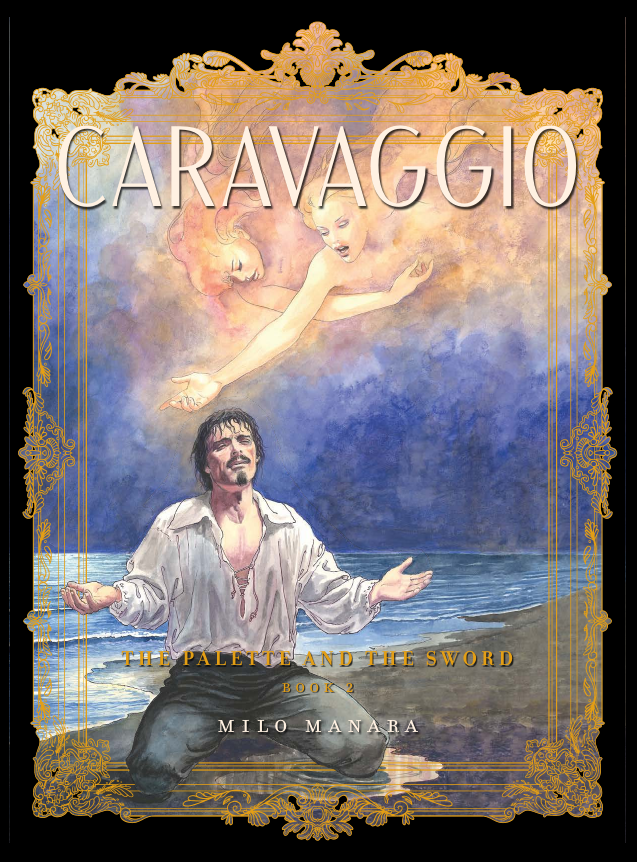
Milo Manara concludes his two-part biography of one of the greatest figurative painters of all time by focussing on the final three years of his life. Book One ended with Caravaggio leaving Rome in a hurry in 1606, having killed an enemy in a duel.
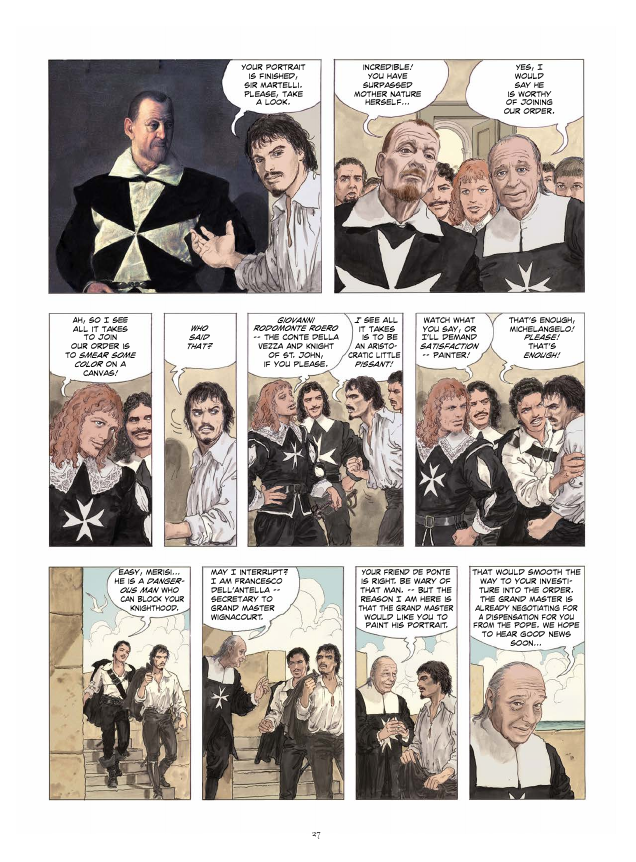
What’s known of Caravaggio’s life has gaps and speculation, so Manara’s treatment is a dramatisation, filling those gaps to construct a story, while the convenience of a painter as the subject permits the indulgence of naked women, Manara’s preferred form of illustration. He indulges, but also remains true to known incidents, and once again, it takes an astonishingly confident artist to produce skilled copies of Caravaggio’s paintings. Manara’s copies are brighter than the known versions, perhaps allowing for the darkening of varnish over the centuries. One features on the sample art and can be compared with a reproduction of the original supplied after the story. It’s accompanied on the page by equally impressive portraits.
Book Two opens with Caravaggio delivered to a camp outside Rome to recover from wounds, followed by a spell in Naples, then to Malta before his final days in Sicily, all the while using his talents to earn money while attempting to clear his name back in Rome. There’s no doubt of his capacity to make enemies wherever he went, and it’s shown how this is always his downfall.
Artistically this is a more expansive volume than the first, which featured the occasional large illustration, but here Manara relishes the varied locations outside the city. Beyond the opening splash extra space is accorded Caravaggio’s arrival in Naples, his creation of ‘Seven Acts of Mercy’, and both his arrival in Malta and departure. They’re breathtaking illustrations exquisitely composed, yet the Maltese scenes are deceptively simple, and Manara’s equally capable of packing small panels with life and detail. In his mid-seventies when he produced this book, there’s no evidence of declining talent.
Caravaggio’s death remains a matter for speculation. Did he die of fever as is officially recorded or was one of his many enemies responsible? Manara opts for a melodramatic combination with the additional emotional tug of the pardon Caravaggio so desired arriving too late. That’s definite dramatic licence, but this was a life packed with drama, and Manara fully delivers it.
Given Manara’s age, another graphic novel would be a surprise, and that being the case what better way to end a career than still at a peak with an accomplished two volume biography of an artist he greatly admired?