
Review by Frank Plowright
There’s a positively perverse start to Azimuth as Dan Abnett supplies a two page introduction barely mentioning the title story, but giving a lengthy explanation about the final Sinister Dexter outing, collected as Bulletopia. It’s a complex summary of a complex story, and greater complexity awaits, but don’t be fooled by Abnett’s almost dismissive rejection of the past. Important nuggets are featured.
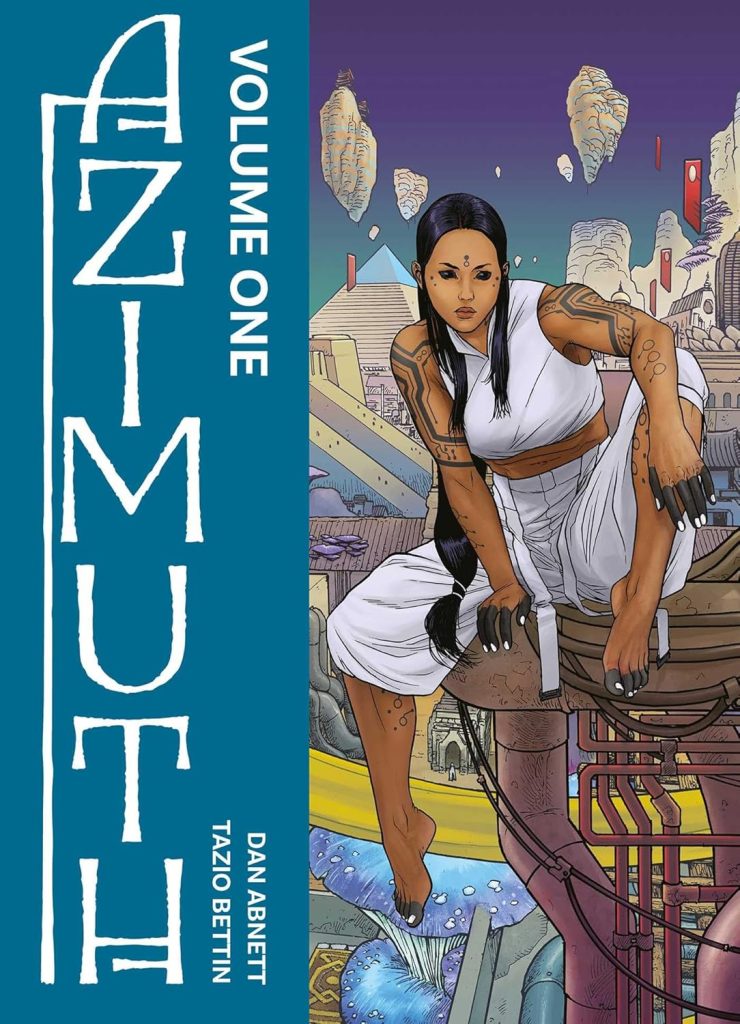
Abnett and Tazio Bettin’s opening page (sample art) is one beauty of a statement. It’s initially Bettin’s stunning designs for the vast landscape of Azimuth that catch the eye, delivering a world of wonder mixing eras and cultures, before Suzi Nine Millimetre herself hoves into view, equally well imposed. The art, though, may detract from the text, and Abnett drops some concepts to mull over, such as the idea of colours hurting. Yes, we’re off to a great start, and the awe continues as we follow Suzi across her section of Azimuth and one strange term after another registers. Gradually some of those phrases will begin to prompt counterparts.
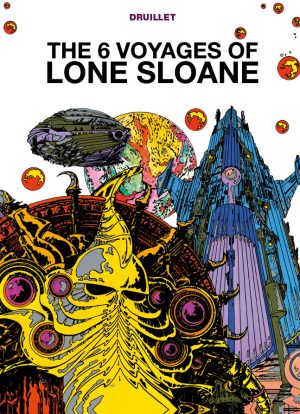
Azimuth resembles nothing so much as the mind-expanding Franco-Belgian SF comics of the 1970s, but with better writing. The amount of information, bizarre characters and new terminology is almost overwhelming as Suzi works her way across the district, all incredibly designed both visually and by Abnett, who’s sorting the weak-willed readers to be discarded. You’ll either want to know more, or will give up despite the magnificent art.
That art starts strong and just keeps giving. How many times have you seen cities of the future that look like Los Angeles with a few hovercars? Bettin fills the pages with strange beings, strange architecture and strange locations, and is great when it starts fraying around the edges. Abnett loves a pun, and feeds throwaway visual variations into Azimuth for Bettin to bring to life. The best of a good selection? Probably Barbi-Yaga.
When Ramone Dexter arrives things become clearer, not least for his method being guns, not conversation, but his presence prompts Abnett to reveals the truth about Azimuth, and only Dexter and his companion know it. He’s got an edge because Lilith can tap into anything, and it transforms Dexter from an extraordinarily effective hitman into something uncanny and beyond, and he soon picks up something making him even better. And just when you believe you’ve figured out Azimuth, Abnett supplies another stunner. It’s audacious and amazing, and all there in the introduction.
Sinister Dexter was a continually under-rated series, and using pretty well the same parameters Abnett has reconfigured it into something new, intriguing and even better. Sequences switch between Suzi and Dexter, each transfer underlining how Azimuth has an incredible conceptual density, taking possibilities and enlarging on them so every new face has a story, and they’re all great. Better still, it’s layered, so readers are aware of what’s happening, at least in a general sense, while few of the cast are. So much is up and running. There’s humour, tragedy, action, and treats in store. You won’t read a better SF thriller this year.