
Review by Ian Keogh
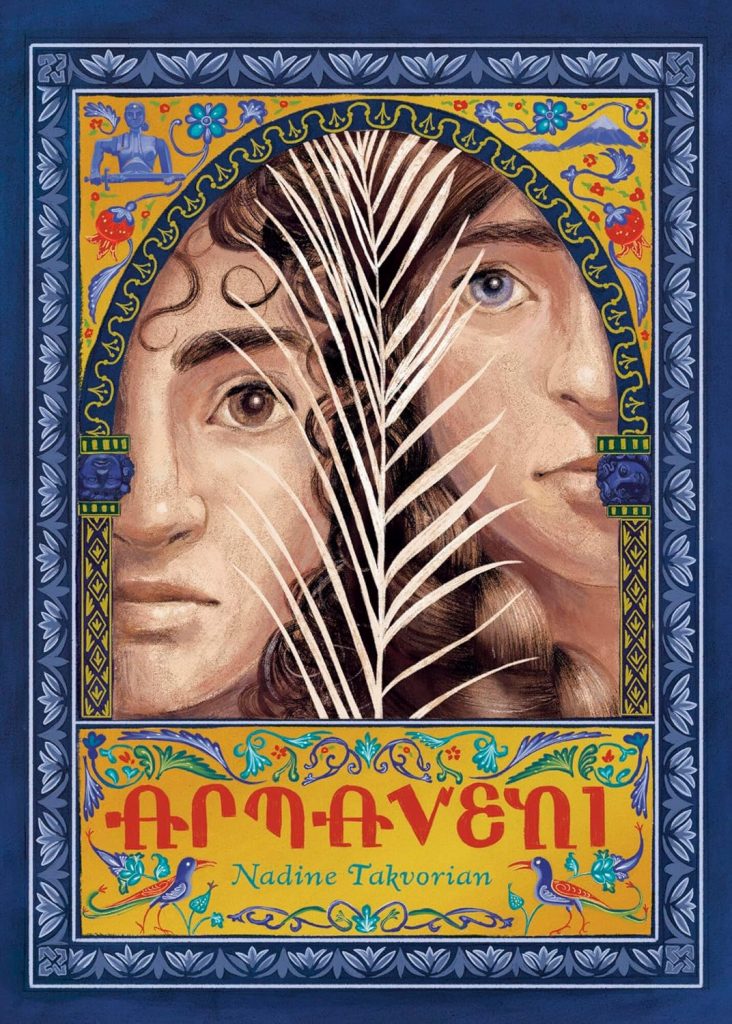
Part autobiography and part family history during dark times, Nadine Takvorian also weaves Armenian myths into Armaveni for an accomplished personal story informative about history.
An indication of the quality occurs over the opening section concerning a minor level of school bullying. It’s the sort of material seen in so many young adult graphic novels, yet Takvorian draws the incidents with an emotional subtlety. She’s growing up in the USA in the late 1990s as part of a family who celebrate Armenian heritage to the point of insisting the language is spoken in the house, yet who emigrated from Turkey. Whenever Nadine asks about her grandmother’s sadness the subject is closed down, but the book’s title is her surname, a world meaning palm tree in Armenian.
Takvorian keeps us guessing about the family tragedy for some while, but eventually begins to tell her grandmother’s story. It ties into what happened to the Christian Armenian people during World War I, which has become one of the first recognised examples of genocide. At the time Armenia was part of the Ottoman Empire, controlled from Turkey, and it’s a source of considerable frustration that over a century later Turkey continues to deny responsibility, much less apologise. In fact, under Turkish law speaking or writing about what happened is criminalised. Worse still, the events of 1915 were the third systematic massacre.
Armaveni is slightly fictionalised via conflating people and timelines for smoother narrative flow, but the themes and issues related are as experienced. Nadine’s parents have just begun to open up about her grandmother when there’s an opportunity for a church trip to Armenia. It brings out schisms between different Armenian groups, and Nadine and her brother later spend time with relations in the family’s home town, now part of Turkey, and learns that prejudice continues to this day.
More usually an illustrator by trade, Takvorian brings an appreciation of people and culture to the art, constantly including drawings of Armenian landmarks, and her people are extremely expressive. The past is separated from the present day of the 1990s via ornately designed header and footer strips, while the use of a dark purple colour in addition to black and white gives a distinctive look to past and present. Atrocities are sparingly told and drawn with restraint still conveying appalling incidents, while the use of a recurring visual metaphor is well handled.
A notable aspect is Takvorian highlighting lower level incidents of prejudice throughout Armaveni, fairly overt in areas of Turkey, yet also extending into her own school. A very readable memoir closes with a brief essay about persecution of Armenians and a much needed glossary of Armenian words used frequently.
So many English language readers may not even be aware of Armenia as a country, much less how the people have suffered historically, nor the continuing troubles they face. Armaveni is a very readable primer on a subject needing greater attention, made more relatable for personal experience.