Review by Frank Plowright
Angus Og preceded Del Trotter by a good two decades as a lifelong opportunist looking for any means to avoid taking a proper job, yet lacks that Trotter heart of gold beneath. He looks out for himself, even if it means throwing his mate Lachie under the passing bus, or more likely the passing cow, as Angus is at home in the Scottish highlands on the fictional isle of Drambeg, a thinly disguised version of Skye. Bain exploits Southern Scotland’s view of Highlanders as having a slow life and quaint customs, but makes it clear Angus is the match of any wily Glaswegian. It’s not seen so much in this collection, but a recurring feature is Angus fleecing naive Scottish tourists.
He did so for thirty years in Scotland’s Daily Record newspaper under the guiding hand of Ewen Bain, yet this is one of only two collections issued while the strip was running. Bain took a while to settle into his distinctive style, but the earliest of these strips was over a decade into his career, so the cast all have their unique noses, and Bain’s fine-lined technique is applied to good effect on a bunch of expressive personalities.
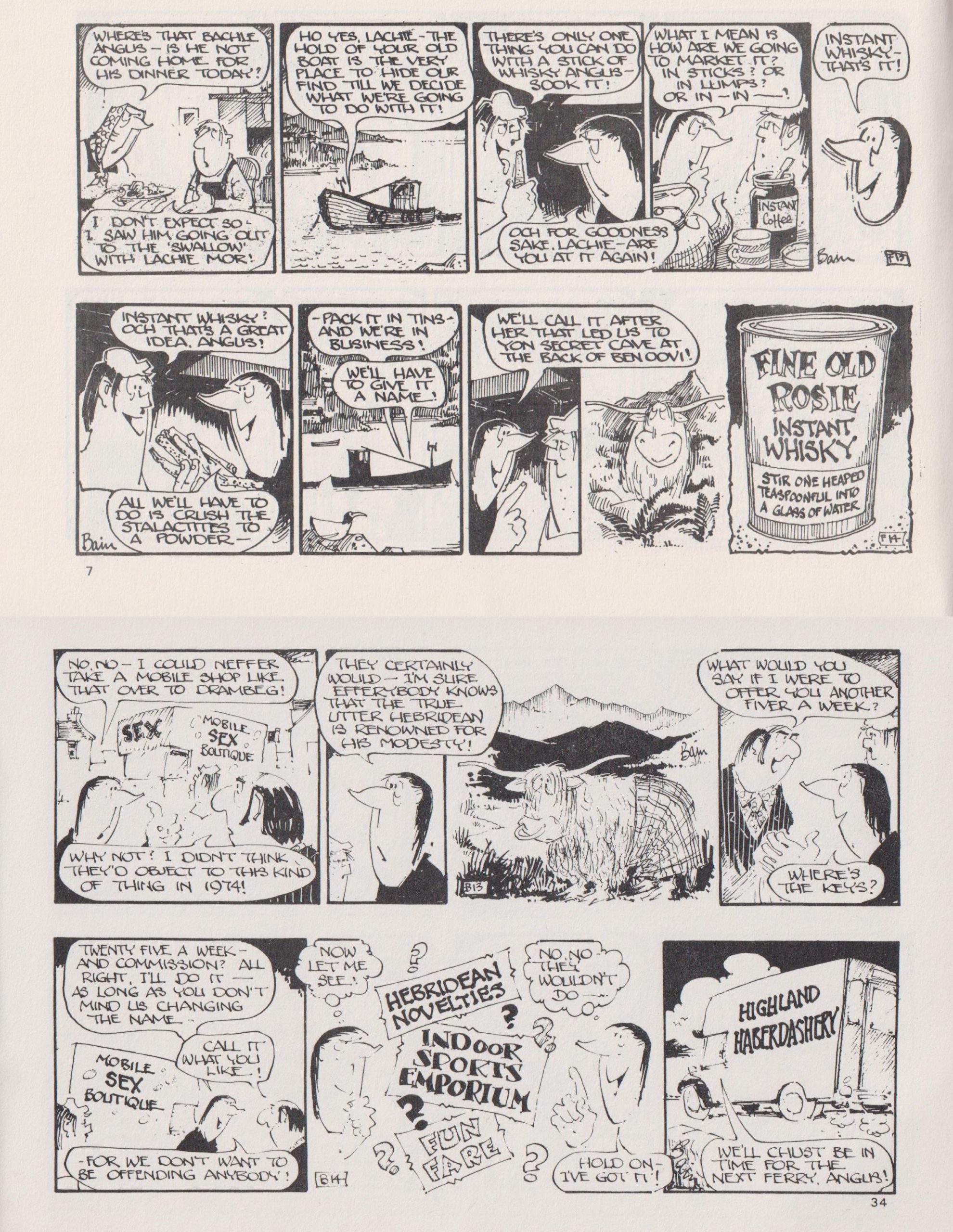
‘Angus Og and the Instant Whisky’ dates from 1974 as Angus discovers a cave in a hillside once used as an illicit whisky still. The whisky has infused the porous rock to such an extent that adding water to the powdered rock will deliver a first class whisky. As Lachie is present when the rock is discovered Angus is willing to cut him in straight down the middle when it comes to profits: 60/40, explaining it as the new metric system at a time when the UK currency had only switched relatively recently. Bain frequently alluded to contemporary culture and events, with Angus’ advertising slogans that so impress Lachie surely copied from products of the time.
Bain is very adept at moving a story forward in four panel stages while building toward a punchline, usually verbal, but occasionally visual, and has a good ear for phrasing and language. Not all the words will transmit outside Scotland, but their meaning will.
1971’s ‘Angus Og and the Mobile Shop’ is an opportunity supplied by the potential disaster of the minister finding Angus a job after his drunken behaviour at a prayer meeting. He contacts someone on the mainland wanting a driver for a van, but doesn’t realise it’s for selling sex aids, a no-no in the Highlands of the 1970s, and Angus is fly enough to have it repainted as a haberdashery van, but word gets around.
Bain concludes with an atypical strip of Angus abroad, having won a trip to Majorca. Pulling him away from his environment results in a slightly weaker experience. Cheap Spanish holidays from the UK were relatively new in 1973, but pastiching the downsides dates the strip, and a running joke about Angus wanting to dump the clootie dumpling his mother supplies as he leaves wears thin. It does, though, result in a good pay-off.
A stock cast of villagers and their peculiarities back up Angus, although not all are seen here, with the absence of old witch Granny McBrochan a shame. While Bain makes jokes about stringent religious observance on the Scottish islands, he also applies a moral code, and for all his scheming Angus never greatly benefits.
Angus is best represented by the 1990 Best of issued after Bain’s death, but the gentle humour, distinctive art and workably eccentric plots make any collection worth seeking out.