Review by Frank Plowright
This review requires spoilers. If you’d prefer not to know, don’t read beyond the sixth paragraph.
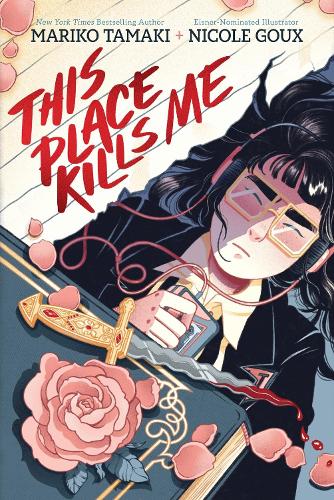
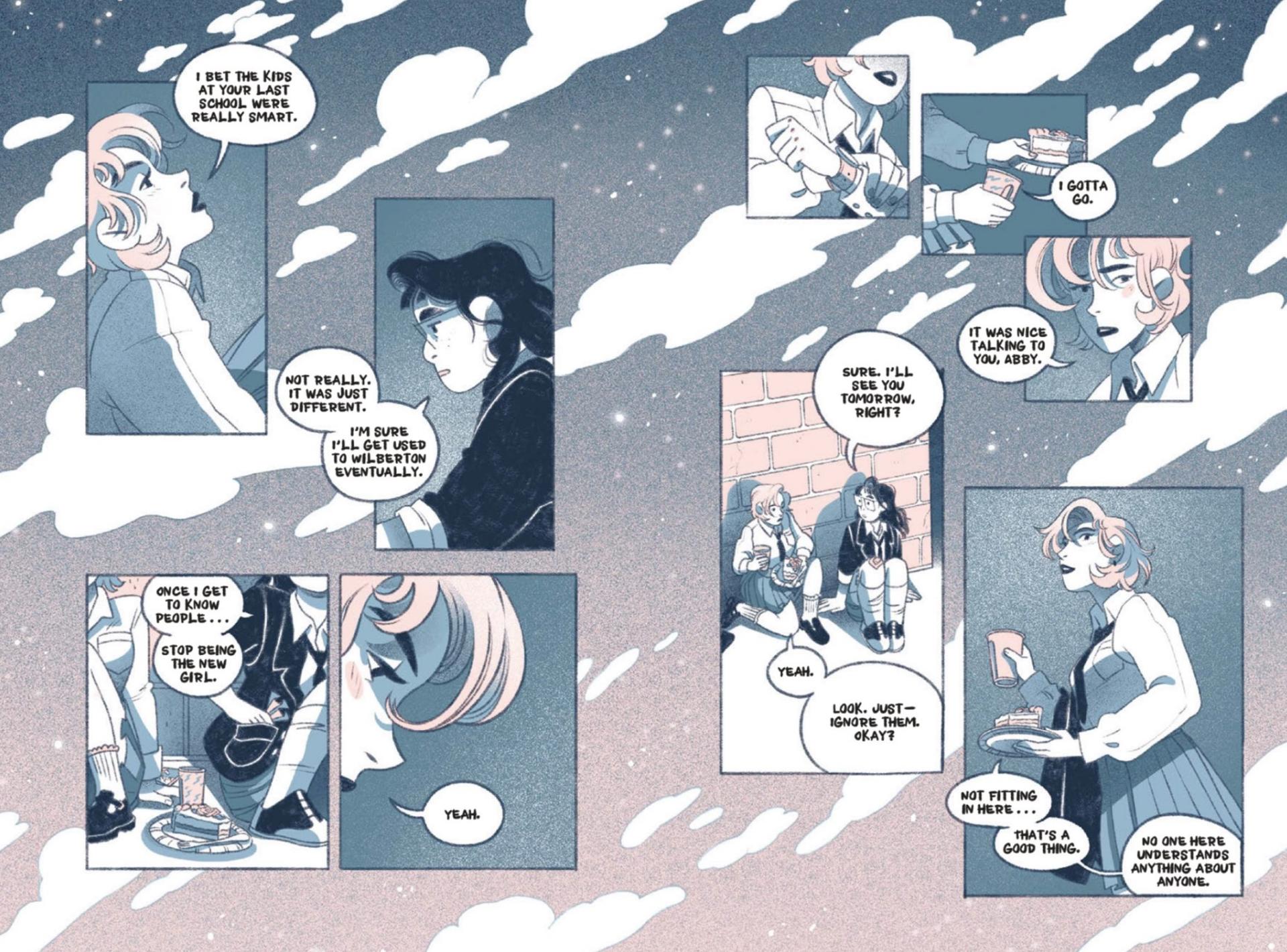
Although it might not seem that way to begin with, This Place Kills Me is a murder mystery set in an elite high school for boarders. The tone is set early with snotty attitudes and cutting comments as Abby Kita navigates the party after the drama society’s performance of Romeo and Juliet. The only person without an attitude is the play’s star, Elizabeth Woodward, which makes it an even greater shame that the following morning she’s found dead, still in costume.
Abby is new to the school and very aware she has little in common with her classmates. They all buy into the school ethos and disdain anyone they see as not fitting a very tight set of socially acceptable parameters. She’s smart, but definitely an outsider, yet that gives her some distance when it comes the circumstances of Elizabeth’s death, and while not intending to start her own investigation, she finds herself in places overhearing information.
Mariko Tamaki sets her mystery in the a nebulous period around the late 1980s and early 1990s, so clunky old personal computers are seen, Abby uses a Walkman, and, crucially, cellphones aren’t common currency. Their invention has greatly benefitted humanity as a whole, but they’re an obstacle for crime writers. As the glue holding the story together, Abby needs to be sympathetic throughout. She’s convincingly established as detached from the school sentiments, but despite being the focus she’s also detached from readers until her past is revealed. It’s a strong scene prompting a stronger one of someone deciding to step away from their petty concerns.
The cast are and their surroundings are attractively illustrated by Nicole Goux, who ensures each pupil is distinct and different looking. Panel placements, though, are random and ever-changing. It’s as if Goux’s experimenting with This Place Kills Me, as there’s now knowing when the page turns if you’ll see a photo strip design, panels overlaid on a bigger illustration or a traditional six panel grid. The art can’t be skimmed, though, as Goux draws attention to matters sometimes not covered in the dialogue.
Abby investigating events is captivating, and the sinister undercurrent is effectively maintained throughout, and that’s why seasoned mystery readers should pick up This Place Kills Me, not because they want to solve the mysteries.
Two mysteries sustain the story. One is distressingly credible, but too obvious as Tamaki only includes two members of staff, one of whom is the only man with more than a bit part, and his behaviour is questionable every time he appears. More members of staff and more men were needed to better obscure his role. The second mystery stems from the first, and is unconvincing. It requires a pernicious romanticising of exploitation, and is dependent on the importance of the school’s reputation being maintained as an overall priority. This could be believed of naive teenagers, but it extends to people who’ve left the school several years previously and are now adults. Would they really remain silent knowing young girls continue to be exploited?
Despite the sensational title and mystery sustaining the plot, Tamaki’s priority with This Place Kills Me is character study, which is extremely well realised to the point of Abby being fit for purpose carrying a sequel. However, more work was required on the mysteries.