
Review by Frank Plowright
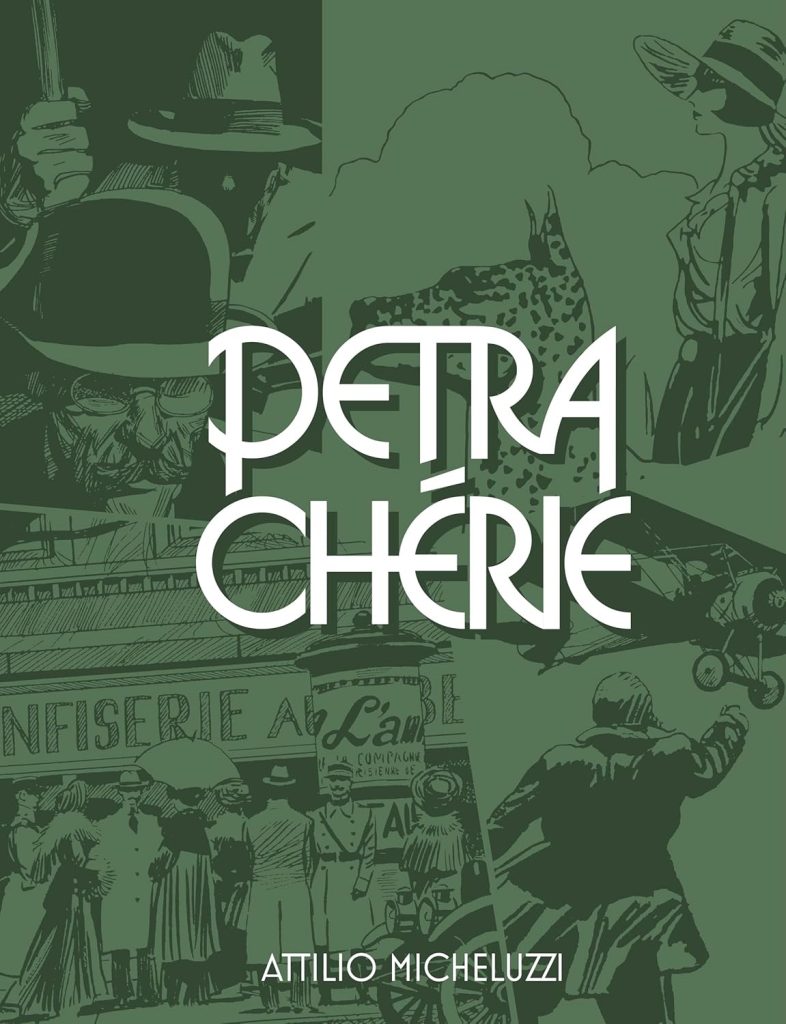
Tiring of architecture, Attilio Micheluzzi turned to comics in 1970, and had refined an already prodigious talent for seven years before beginning work on signature series Petra Chérie. Starting with ten page episodes, then expanding to a dozen, Petra’s exploits take place during World War I, an era chosen to allow Micheluzzi to indulge of his love of exotic byegone locations and early aircraft.
This collection begins with a three page strip Micheluzzi drew in 1982, introducing readers of a new magazine to an already established character. Petra is adventurous and curious, while wealthy enough to indulge her passion for flying planes, unconcerned with roles the contemporary society expected women to slot into. That’s exemplified in an opening strip where she helps British fighting planes in occupied Belgium, seeing off German pilots. Both sides see the intrusion of an unmarked plane breaching unwritten protocol.
As well as representing Petra’s motivations extremely well, it highlights Micheluzzi’s deeper regard for period accuracy in the responses of officers, as ludicrous as their form of honour might seem to us, and in making use of a polyglot background. Petra grew up in China and has a Chinese assistant Nung, and while their relationship now might seem patronising at best, in 1977 his presentation was a giant step forward. He’s an equal partner in Petra’s affairs, able to remain invisible in places where she would be noticed, and both advisor and source of information.
While the stories start well and involve ever more intricate plots, it’s the artwork that really sells them. Strangely for an Italian artist, the first strips appear influenced by the work of Alex Toth on DC’s early 1970s war titles. There are similar uses of packed small panels, sound effect lettering highlighted and people with eyes rarely visible, but Micheluzzi’s line is thinner and there’s greater detail. Perhaps they both drew from the same source. While retaining a cinematic sweep, he rapidly moves away from that style, though, and a series characteristic is constantly changing artistic styles, settling eventually on textured black and white. A weakness, though, is a lack of emotion under any circumstances, which is also applicable to the writing until the final episodes.
As far as the writing goes, a prevailing intelligence connects interesting explorations of various cultures and faiths. Petra’s presence setting off a series of events is a regular device, although it’s rare she visits somewhere without foreknowledge. As a woman she’s under-estimated, and while Micheluzzi frequently over-plays the social prejudice she’s aware she’s able to access what others wouldn’t, yet plots confound expectations because Petra doesn’t always succeed. However, while certainly entertaining, Micheluzzi the writer isn’t as accomplished as Micheluzzi the artist. For a long time slavery to historical accuracy leads to extraneous explanations, the dialogue can be overly arch and some solutions are just too incredible and convenient. When Micheluzzi introduces second person narrative captions around halfway you’ll fear for the worst, but that’s when everything other than emotional weight actually slots into place, beginning with a five chapter journey across Europe, brought to an abrupt close.
Self-interest, fantaticism, nobility, greed and inevitability are themes explored in superbly drawn stories the latter of which would be masterpieces if only Micheluzzi didn’t so underplay human emotion.