Review by Frank Plowright
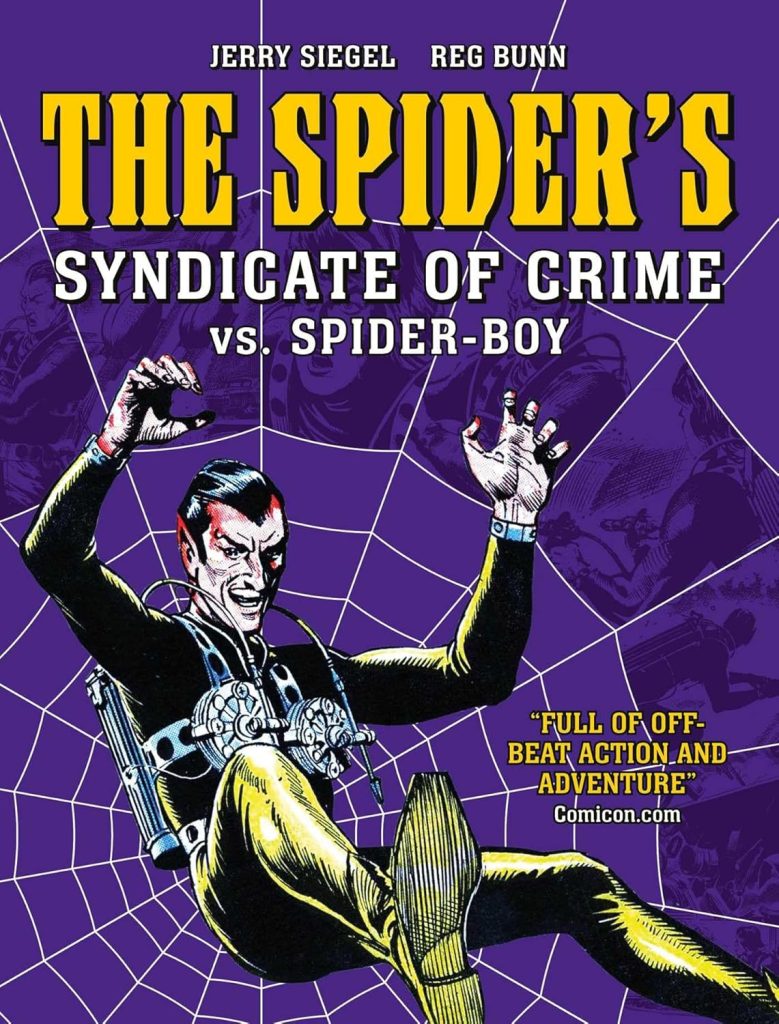
Once a master criminal, the Spider has long reformed, so quite why the series continues to be titled The Spider’s Syndicate of Crime is puzzling. He now pits his formidable intelligence against wrong-doers. An acerbic and arrogant personality made him stand out among others after whom strips were titled in 1960s boys comics and here he faces a would-be doppelganger. Extras are few in this volume as Jerry Siegel and Reg Bunn’s title strip runs to 98 pages.
Outside American reprints, The Spider was the nearest British readers of the 1960s came to a superhero strip, and the experience of Superman’s co-creator at the helm ensured a succession of awe-inspiring feats and tricky problems. Starting this story the Spider is framed for a gangster’s murder, and events thereafter make it seem as if he’s not only guilty, but that he’s returned to a life of crime. Readers are aware, though, that an imposter is responsible for the crimes. That’s not the only threat as a criminal genius has also targeted the Spider, and his inventions are responsible for a succession of assaults and robberies.
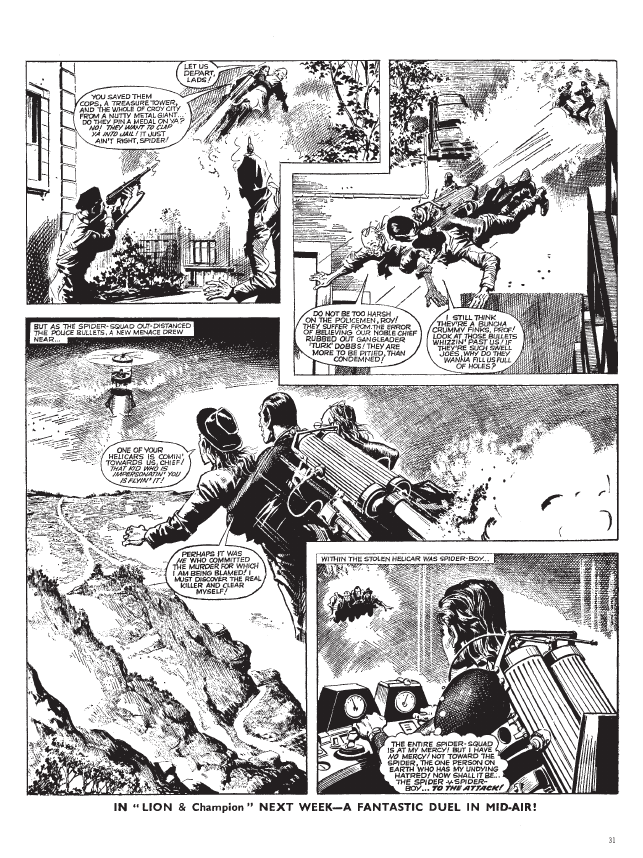
The Spider’s been in similar situations before, not least in previous volume The Crime Genie, but the threats are different enough to survive the repetition, while the amazing art of Reg Bunn also goes a long way. Rather than treat the action as a superhero strip Bunn does everything to drag it back to understandably human possibilities. Technology isn’t disguised by costumes, but worn as wires and metal braces for the world to see, while a gangster turned giant-sized goes about his business in trilby hat and tweed coat. Usually filling pages with impeccably conceived and detailed backgrounds, one hell of a workload over five pages of art per week, there are places here where Bunn concentrates on the figures. Even then the crosshatched backgrounds add tone and substance, on occasion used in misty form with outlines obscured beneath.
Spider-Boy’s secrets are important enough to the overall plot to merit a relatively lengthy revelation sequence prior to the inevitable showdown, for which Siegel raises the stakes via an unusual location.
As noted, extras this time are few, but an alternate ending is included. Around twenty pages needed cut when the strip was reprinted in an annual several years later, with the decision made to shorten the ending. John M. Burns drew two pages wrapping things up far more rapidly, and with greater contrivance, and they’re supplied along with a text and illustration of the Spider facing the Fly.
There are places where the plot jerks a little, and Bunn’s art may be meticulous, but ordinary people resemble those from previous decades, not the mid-1960s. However, Siegel keeps the thrills coming, especially in a frenetic finale involving giant animals, and there’s a lot of fun to be had here.