Review by Lewis Savarese
In Jumpscare, Cullen Bunn and Danny Luckert unleash the eponymous vigilante upon the miscreants and eldritch horrors of Empire City for their second foray into the Beyond Mortal Universe. During a chance encounter with an elder god, a young woman named Allie Perry (a horror movie junkie and lover of all things macabre) is imbued with extraordinary abilities: in addition to super strength, she can conjure any weapon from her favorite films, and teleport to places where no one is looking. Unlike the pastiche superheroes in Beyond Mortal, Bunn creates a protagonist with distinctive characterisation and potential.
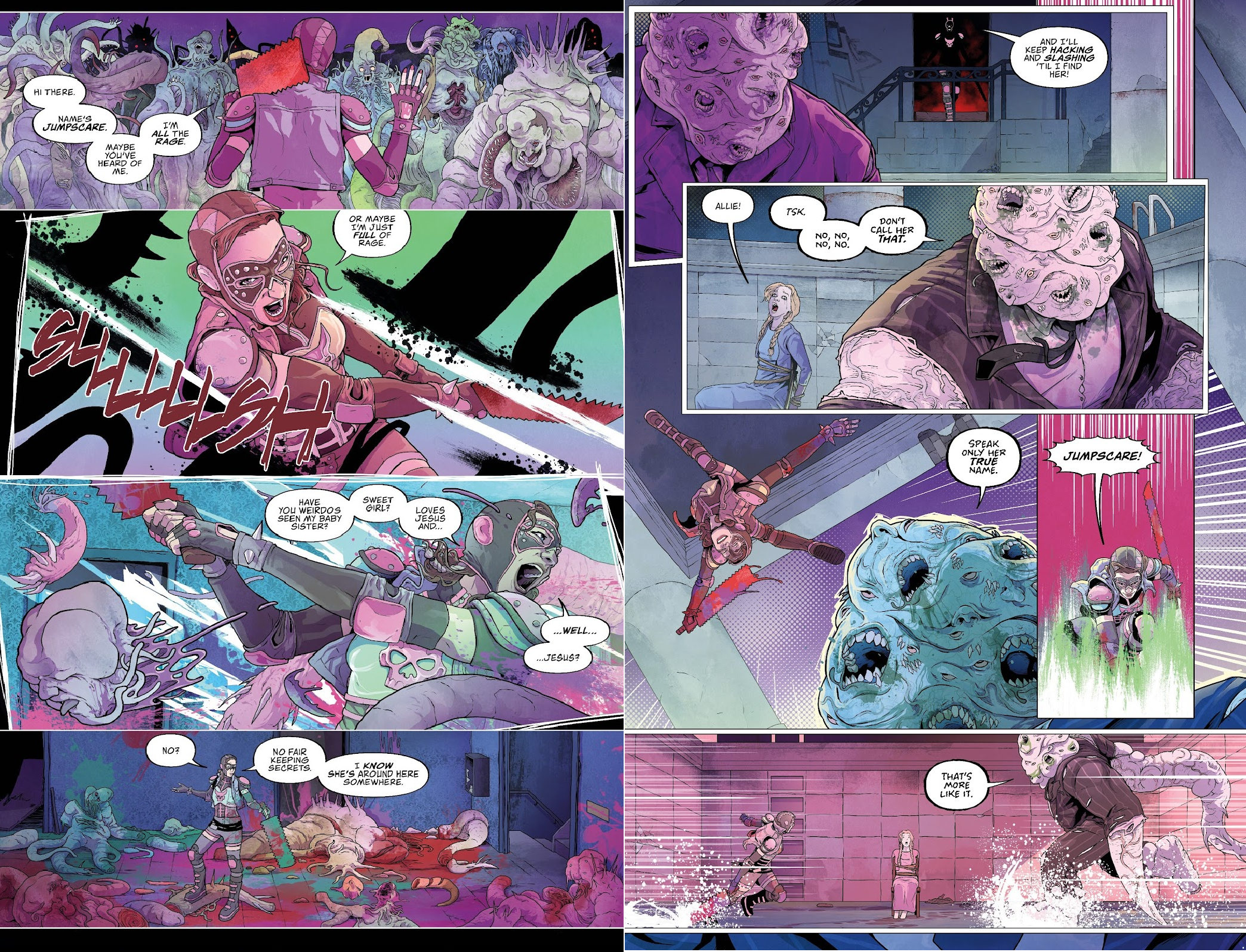
Jumpscare’s origin story takes up a relatively small portion of an already slim book, much to the narrative’s benefit. Before becoming Jumpscare, Allie Perry was the black sheep of a wealthy evangelical Christian family living in the suburbs of Empire City. After Allie is forever altered by a cosmic being, Bunn and Luckert eschew the obligatory sequence of Jumpscare exploring her new powers for a series of frenetic confrontations with monsters, criminals, and a cadre of hired guns. Luckert depicts Jumpscare as a spirited scrapper who never shies away from a fight and improvises on the fly (especially when conjuring weapons). However, she is very much an amateur vigilante, with a homemade costume resembling an overdesigned roller derby kit and a proclivity for posing mid-brawl. Bunn injects Jumpscare with a gleefulness that he clearly shares. He achieves considerable mileage from creating parodic movie titles and the respective weapons Jumpscare conjures from them (e.g. a chainsaw from Blood on Mama’s Pillow). Jumpscare’s quips are equal parts infectious and irritating, which adds to Bunn’s portrayal of a twentysomething horror cinema fanatic who recently cast off the yoke of her insular upbringing.
The main thrust of the narrative involves the abduction of Jumpscare’s estranged sister Rebecca by the mobster turned monster, Grindhouse. Like Jumpscare, Grindhouse was changed by the Leviathan, a pantheon of elder gods vanquished by the superhero team the Alliance in Beyond Mortal. Grindhouse’s character design is unremarkable, a many-mouthed tumorous growth bulging out of a pinstripe suit. In pursuit of both Jumpscare and Grindhouse are the similarly forgettable Leviathan worshipping cult, the Dismal Concordat. Among their ranks are several Dark Souls rejects and a wannabe runner xenomorph from Alien 3. The Dismal Concordat are gathering up “Leviathan-touched” individuals as they prepare for the return of the Leviathan. Although they ultimately do not amount to much here, one can presume that Bunn will put the Dismal Concordat to better use in future volumes of the Beyond Mortal Universe.
After the second chapter it becomes evident that Jumpscare would have worked better as a one-shot. Bunn stretches a thin story even thinner with page after page of Jumpscare monotonously dismembering tentacled fodder. Luckert’s panel layouts and blocking are dynamic, but there is a limit to how much flying carnage a story needs. By the end of the book there are a couple of intriguing loose ends worth exploring in a follow-up volume, but we will have to wait some time as the next book in the series is the forthcoming The Murk.