Review by Frank Plowright
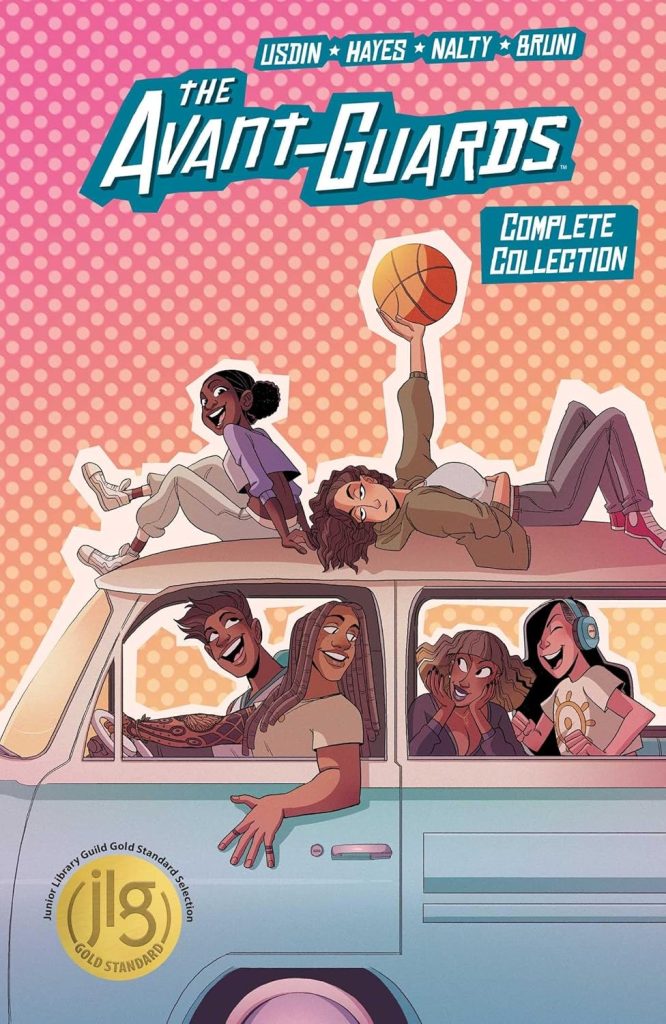
The Avant-Guards is a twelve chapter story about assorted outcasts, loners and mavericks bonding together at art college via the formation of a basketball team to join a newly-formed league. It’s a gender-positive story that avoids flaunting the virtue, good-natured and understanding in the way the cast progress, and excellently drawn all the way through.
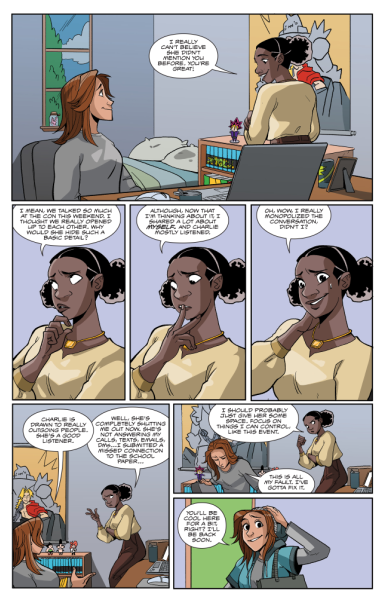
The way into the series is Charlie Bravo making a new start at a new college, and one of the few mis-steps writer Carly Usdin makes is landing her with a daft name for the sake of a single line joke near the beginning. Her surname has no later relevance. For a fair while she and the ebullient Liv are predominantly featured, but over the course of the entire book almost every team member takes a turn in the spotlight even if they seem one-dimensional to begin with. It’s enough to carry them through the formation of the team and the first crisis.
Also carrying them into that is series designer and main artist Noah Hayes, who delivers a virtuoso performance, especially strong with facial expressions defining people. It’s never stated that Liv has ADHD, but she certainly behaves in a manner consistent with the condition, and Hayes supplies her energy and feelings to a greater level than the remainder of the cast, although they’re by no means neglected. It’s relatively simple cartooning otherwise, although always attractive, and enhanced by the flat and bright colouring of Rebecca Nalty. There’s a real chance for Hayes to shine toward the end with a series of single page portraits of individual cast members. For reasons unknown, and without a cover credit, the final chapter is drawn by Gabriele Bagnoli who’s also very good and manages to match Hayes’ style well.
Don’t pass this by just because you’ve no great interest in basketball. The sport is just a peg on which Usdin hangs her dramas, and although the occasional game features, her priority for The Avant-Guards is mashing the cast together and seeing how they cope with the challenges thrown at them. Funny, warm and understanding, there’s room for everyone to grow, and while you can still pick up three paperback collections starting with Volume One, the entire story between two covers is more satisfying.