Review by Frank Plowright
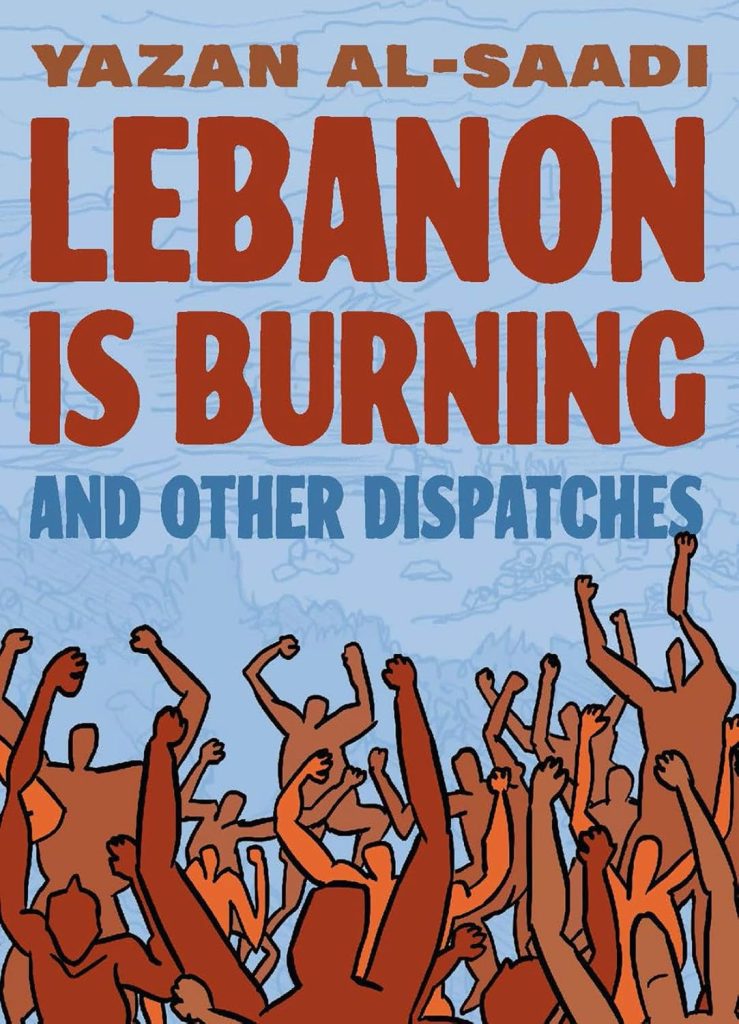
Yazan Al-Saadi is a Syrian-Canadian journalist who’s worked with Médecins Sans Frontières, and Lebanon is Burning and Other Dispatches is a look at assorted Middle-Eastern and North African countries since the Arab uprisings of 2011. While this collection has a wide attention span, All-Saadi is based in Lebanon, where the selection opens with the title strip.
Unfortunately Lebanon is Burning rapidly becomes bogged down by a desire to explain complex situations and references not using the comic format, or even the traditional footnote. Instead each of the fourteen strips is prefaced not only by an introductory essay, but detailed additional comments offering greater context. This is in strips already offering a high word count and explanatory captions. It’s a messy and complicated way of dealing with matters, and all the more surprising for Al-Saadi’s introduction referencing Joe Sacco as an influence. Sacco deals with equally complex situations, but explains them clearly within his strips.
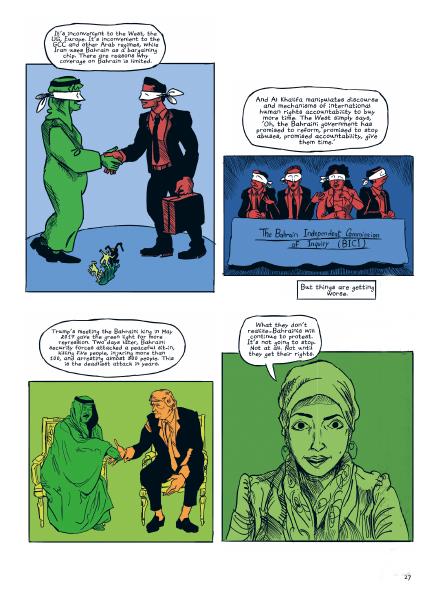
That’s a shame, as is the title and opening strip having artwork looking basic and rushed. Perhaps its intended to convey the movement and intensity of dangerous situations, but Omar Khouri’s subsequent art on a strip about Syria is far more polished. Ghadi Ghosn supplies the sample art and contributes more pages than any other artist, roughly a third of the book. He’s very adaptable, able to supply diligent portraits, effective cartooning or almost abstract representations. Other art varies between diagramatic and cartooning, with a middle ground most common.
From his introduction offering an admirably spirited argument against objectivity being journalism’s primary aim, Al-Saadi is incredibly informative and his comments will burst any comfort zone. He accuses humanitarian organisation Médecins Sans Frontières (translated as Doctors Without Borders) of institutional racist structures, some employees of less than humanitarian attitudes, and losing sight of their aims. He talks about how economic methods designed to hamper dictators bring misery to ordinary people long before they reach the top of the tree, and how allegedly friendly regimes have disgusting human rights records. To some readers, of course, this won’t be news, yet first hand experience in a number of nations ensures Al-Saadi has something of value to impart to even the more informed.
The economic exploitation trickles down to individuals willing to prey on the poorest in their desperation, but an undeniable common factor is other nations enriching themselves on the backs of misery, slaughter and repression, turning a blind eye as long as their economic needs are served. Al-Saadi is rightly uncompromising on that matter, but he’s not above admitting personal experiences have changed his mind on others, as in a chapter comparing regimes in Cuba and Syria.
There’s no denying this is a cheerless chronicle over a dozen nations, but imagine what it must be like to live through some of the situations Al-Saadi explains. Perhaps of greatest relevance since the book was completed is the chapter on the history of conflict between the Israeli state and Palestinian people. Published before the current atrocities began, Al-Saadi ends by recognising a seventy year struggle and wondering what calamities the next seventy years will bring. Depressingly, he didn’t have to wait long.
It’s going to be a rare reader who’ll devour the textual density of Lebanon is Burning in one sitting. Al-Saadi’s research is detailed and his views occasionally original, and they demand some contemplation. Despite the awkwardness of the format, this is a chronicle for the ages.