Review by Frank Plowright
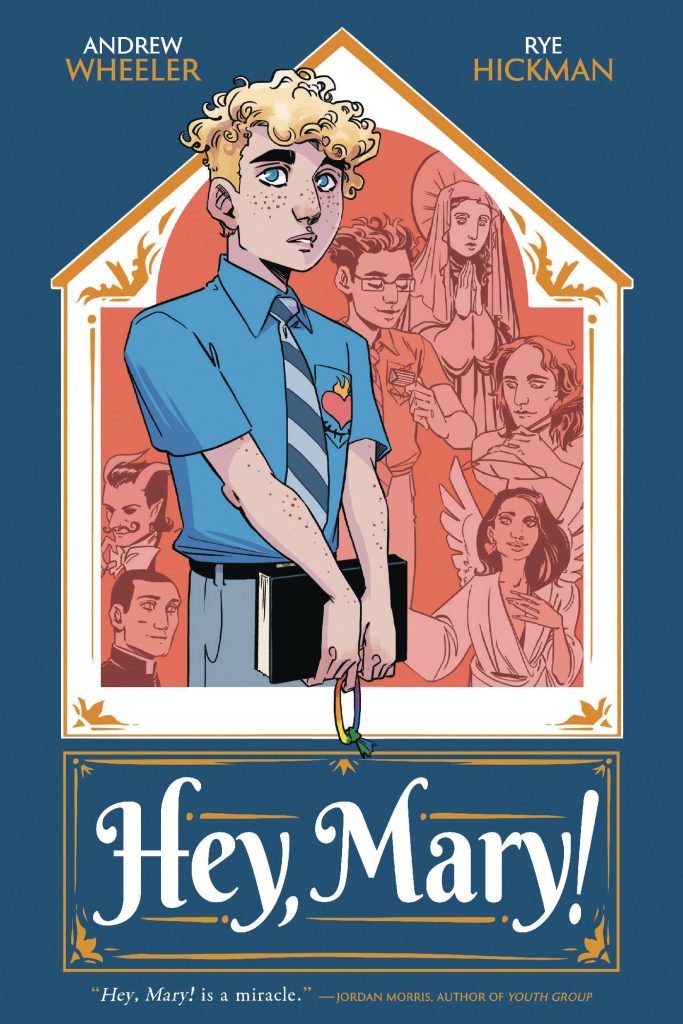
Hey, Mary is aimed at the young adult market and concerns reconciling the strictest Catholic ideology and beliefs with being attracted to someone of the same sex.
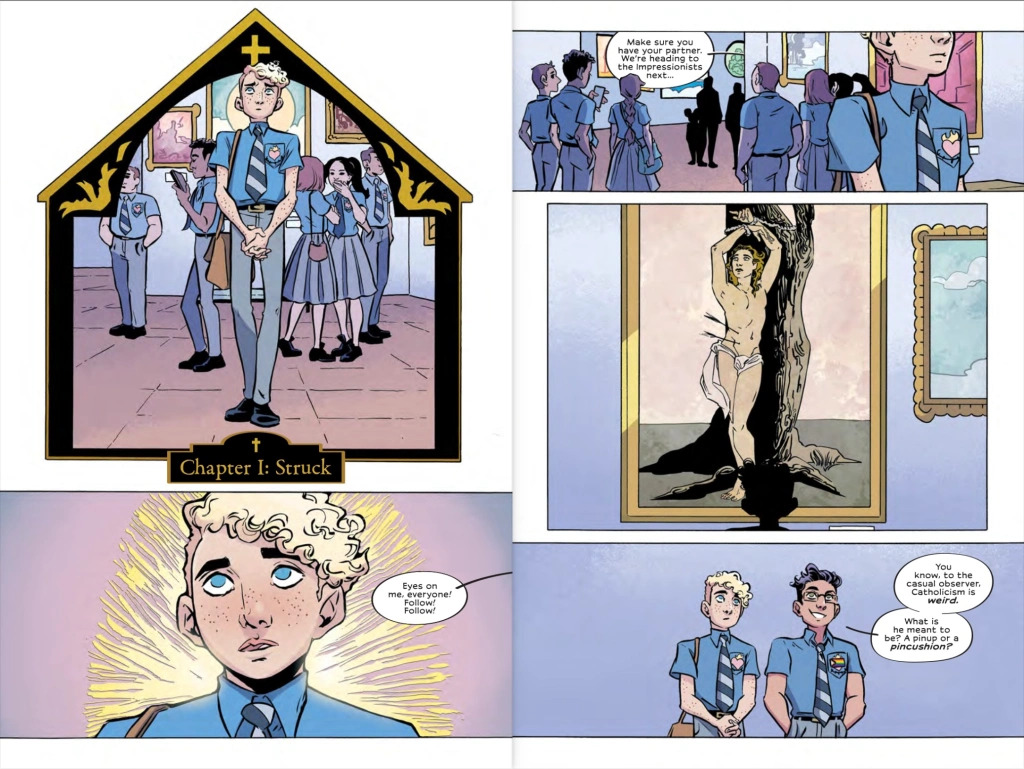
Mark is a teenager repressing his attraction to openly gay classmate Luca. His family are very active in their local church, and remark to the new priest that as a child Mark treated the Virgin Mary as an imaginary friend, hence the title. Andrew Wheeler explores that idea throughout as Mark has conversations with assorted personalities, ranging from the Biblical to creative greats, beginning with Saint Sebastian talking from a museum picture. Mark’s crisis point comes as Luca is about to depart for a new school and he’s going to deliver the Sunday lesson from the pulpit for the first time.
Rye Hickman draws a repressed Mark, always looking fearful and conflicted, which is no surprise as one person after another supplies advice and opinion, when for Mark faith has always been absolute. His internal dialogues with historical figures echo that reality. Hickman illustrates these in a way bordering on amusing, which is appealing, but crucially never destroying the central message.
Catholics struggling with their identity and how it conflicts with church teaching isn’t a widespread topic among young adult graphic novels, and Wheeler’s approach is certainly going to strike a chord with some readers. His playing out of ethical dilemmas and Biblical contradictions is handled respectfully with regard to both facets of the argument, although it doesn’t shy from atrocities committed in the name of god over the years. It presumably echoes the arguments many youngsters experience. In that regard it’s going to be immensely helpful, but anyone reading Hey, Mary without concerns about religion or identity will find that in making his case Wheeler all too often lapses into preaching.
It’s a secondary concern when weighed against people Wheeler and Hickman are likely to help. They can’t cover every argument or all aspects of bigotry, so Catholicism as experienced by some readers could be more absolute and unforgiving, but there’s plenty of food for thought for anyone facing the same contradictions in their own life.