Review by Colin Credle
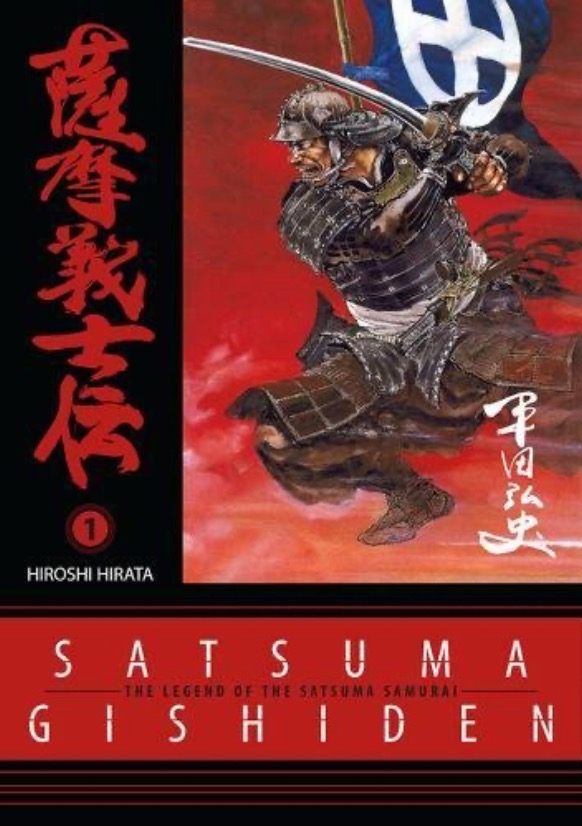
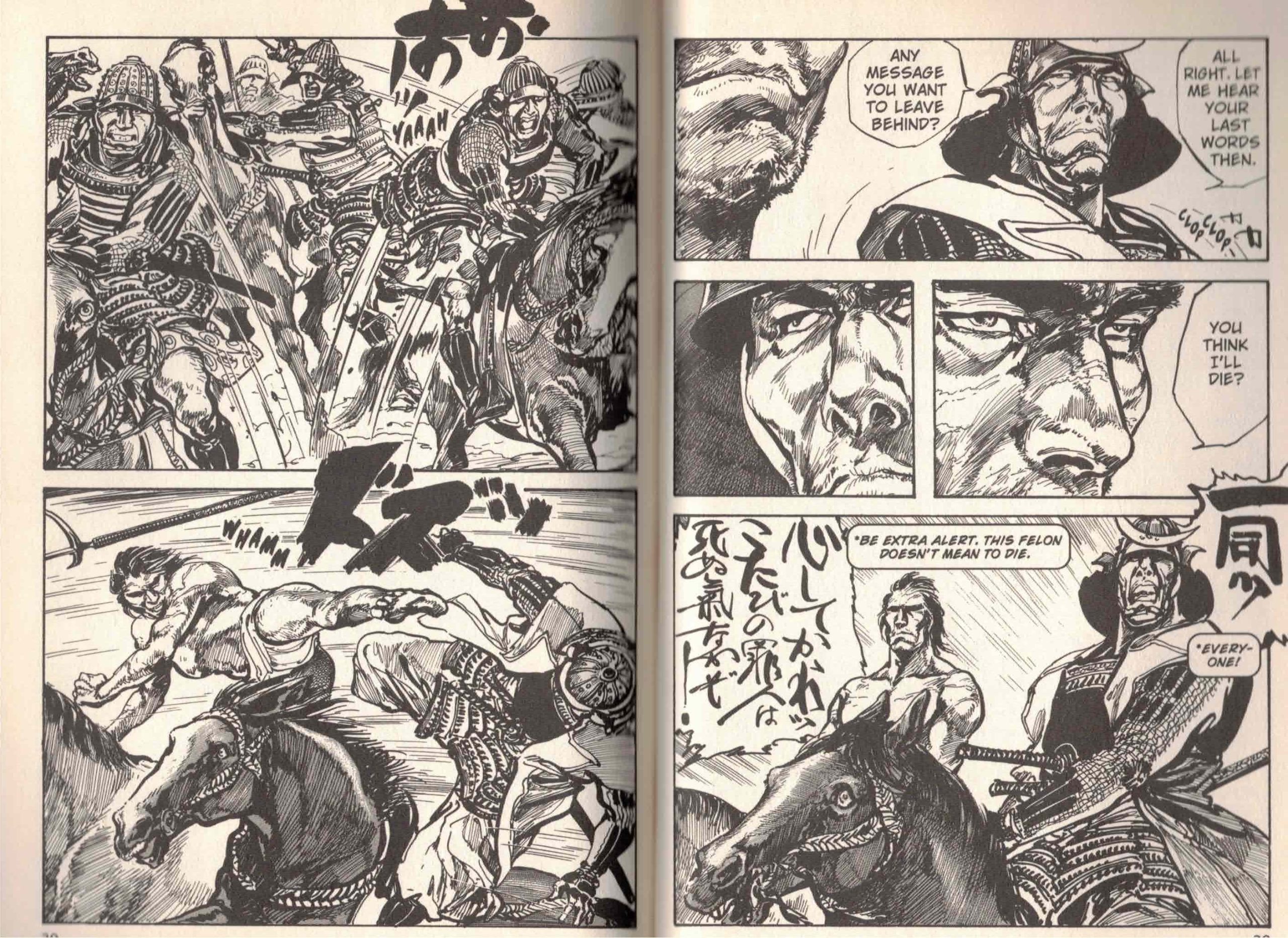
In Hiroshi Hirata’s first volume of Satsuma Gishiden we are immediately thrown into a violent martial tradition of Edo era Japan called “Hiemontori”, literally translating as “grabbing something bloody.” To keep Samurai trained and war ready, a condemned felon is released on horseback to an open field while two competing teams of Samurai vie for removing his liver. There are no limits, no rules but if the felon succeeds in reaching a tall cypress, he is rewarded with his freedom. Hirata’s gritty black and white hatch work is stark, gripping and gruesome. We see the sinew straining, muscles rippling and the disdainful expressions of upper caste Samurai for “yam eating Goshi samurai”, and Hirata’s Japanese calligraphy is so well regarded that it was kept intact with subtitles added to translate.
For thirty pages, the sweeping action includes not only fleet weapons and warriors, but horses, sword fights, gory dismemberment and an unexpected seppuku to wrap it up with a dramatic close. Little of this is linear and it doesn’t follow a predictable trajectory.
The likelihood of surviving “Hiemontori” is almost nil until our anti-hero Shiba Sakon enters the scene. Sakon is a “Goshi” Samurai, a samurai who does not live in the castle and is forced to find other means to pay for his food, while his options are restricted to a shortlist of professions by local law. Hirata is careful to explain the caste system without his story losing any momentum. Setting the stage becomes critical as we begin to understand how ingenious Sakon is at skirting these suffocating social restraints to navigate through with reckless abandon and surprising results.
Satsuma Gishiden is a pungent antidote to a common ailment today: presentism. Presentism is judging the past according to today’s more evolved morality, but unfortunately requires completely ignoring the moral code of the time. Hirata helps us travel through time, he convincingly explains the world view of those that lived and knew nothing else but the norms of the day. Samurai could legally execute a passerby with impunity, only having to present a curt justification on paper to the authorities, and negotiating with a “Goshi” samurai to build your house becomes a lot riskier in the caste system of Edo Japan: even though you’re paying him, if you offend him, he could chop your head off.
Hirata invites us along, explains the cultural landscape and then we watch with fascination as an expert adroitly navigates through it all. At the start Sakon’s behaviour is unclear, but as the story unfolds layer by layer, we appreciate how one iconoclast can not only survive, but thrive despite all efforts of society to hammer that nail down.
The only shortfall is Dark Horse’s decision to publish in small pocketbook format, which is unfortunate, but not enough to avoid reading it.